HH.The Moment Doc Holliday Steals the Movie: Why Val Kilmer’s Final Confrontation in Tombstone Still Hits So Hard
There are movie scenes that are remembered because they are loud, explosive, or visually spectacular. Then there are scenes remembered because one actor seems to take complete control of the screen. The confrontation between Doc Holliday and Johnny Ringo in Tombstone belongs firmly in the second category.
By the time this moment arrives, audiences already know that Doc Holliday is dangerous. They have seen his sharp tongue, his quick draw, his loyalty to Wyatt Earp, and his willingness to walk toward trouble while everyone else is searching for a way out. But this scene does something more. It transforms Doc from a memorable supporting character into the emotional and mythic center of the film.
Val Kilmer does not need a long speech to make that happen.
He needs a hat, a gun, a quiet voice, and a look that tells Johnny Ringo he has finally met the one man who is not afraid of him.
The setting makes the scene even more powerful. There is no crowded saloon, no cheering audience, and no dramatic courtroom of witnesses. The confrontation unfolds outside, surrounded by trees and natural light. That simplicity strips away everything unnecessary.
Two men.
Two reputations.
One inevitable outcome.
Johnny Ringo arrives expecting Wyatt Earp. He believes he is about to settle a personal score. Instead, Doc Holliday steps out to meet him.
That surprise changes the energy immediately.
Ringo is a man who has spent much of the movie intimidating others through reputation and violence. He wants people to know he is dangerous. He enjoys the fear that follows his name. Doc is the opposite. He rarely has to prove anything.
He simply appears.
That is one of the reasons the scene works so well.
Doc does not enter like a man preparing for his greatest battle. He enters almost casually. Val Kilmer gives him the same dry confidence he has carried through the entire movie. There is no exaggerated anger and no desperate attempt to look brave.
His calmness is the threat.
The scene becomes a psychological duel before either man reaches for his weapon.
Johnny Ringo immediately understands what has happened. He knows Doc is not an ordinary opponent. Their earlier encounters established a strange respect between them, but also a rivalry. Both men understand speed. Both understand violence. Both understand that the other is capable of killing without hesitation.
But Doc has one advantage.

He is not afraid to die.
Throughout Tombstone, Doc Holliday’s illness hangs over him like a shadow. He is visibly sick, weakened by tuberculosis, and constantly reminded that his life is running out. In another character, that might create fear.
In Doc, it creates freedom.
A man who already expects death is difficult to threaten.
That becomes especially important in this final confrontation. Johnny Ringo has built his identity around being more dangerous than the people around him. But how do you frighten a man who has already made peace with dying?
You cannot.
Doc’s illness, which seems like his greatest weakness, becomes part of his strength.
Val Kilmer plays that contradiction brilliantly.
He looks pale and tired. His body may be failing him, but his mind is completely focused. There is a stillness in his performance that makes the scene more intense than a dozen explosions could.
He does not rush.
He does not shout.
He does not need to.
Every pause tells Ringo the same thing:
Doc came here because he wanted this fight.
That detail is crucial.
He is not trapped.
He is not forced into the duel.
He chooses it.
And he chooses it for Wyatt.
This is where the scene becomes more than a showdown between two gunfighters. It becomes a scene about friendship.
Doc Holliday could have remained somewhere safe. He is sick. He is physically exhausted. Nobody would blame him for staying away.
Instead, he takes Wyatt’s place.
That tells us more about Doc than almost any speech could.
His loyalty is not expressed through sentimental words. It is expressed through risk.
He knows Wyatt is consumed by revenge and anger. He knows that Wyatt is walking toward another deadly confrontation. So Doc steps in and removes one of the greatest threats before Wyatt arrives.
He does not announce that he is sacrificing himself.
He simply does it.
That is why the relationship between Wyatt and Doc remains one of the strongest parts of Tombstone.
Wyatt represents purpose, law, responsibility, and rage. Doc represents wit, chaos, fatalism, and loyalty. They are very different men, but they understand each other in a way few other characters do.
Doc’s confrontation with Ringo is perhaps the ultimate expression of that bond.
The filmmaking also deserves credit for allowing the tension to breathe.
Modern action movies sometimes rush toward gunfire. This scene understands that the moment before the draw is more important than the shooting itself.
The audience watches their faces.
We watch their hands.
We listen to their voices.
We wait.
Every second increases the pressure.
That is classic Western storytelling.
The gunfight is not simply about who can fire fastest. It is about who loses control first.
Doc never appears to lose control.
Johnny Ringo does.
There is a subtle but important change in Ringo’s behavior as the confrontation develops. At first he tries to maintain his confidence. He has a reputation to protect. But the longer Doc stands there calmly, the more that confidence begins to crack.
Ringo realizes that the usual intimidation will not work.

Doc knows exactly what he is.
He knows exactly what this moment means.
And he is still smiling.
That smile is one of Val Kilmer’s greatest weapons in the entire film.
Throughout Tombstone, Doc often smiles at the worst possible moment. When normal people would become nervous, Doc becomes amused. When someone threatens him, he seems entertained.
It creates uncertainty.
Is he joking?
Is he serious?
Is he about to kill someone?
Often the answer is all three.
The moment the gunfight finally happens, the violence is quick.
That is another reason the scene feels believable within the mythology of the Western. There is no endless exchange of bullets. There is no elaborate choreography.
The duel is decided almost immediately.
Doc is faster.
Ringo falls.
And suddenly the man who spent the movie cultivating fear is lying against a tree, dying in disbelief.
The scene does not end with victory celebration.
Doc does not shout.
He does not raise his arms.
He does not behave like a man who has just accomplished something extraordinary.
He remains Doc.
That consistency is essential.
For him, the confrontation is not about glory.
It is simply something that needed to be done.
When Wyatt later arrives and discovers what happened, another layer of the scene becomes clear. Doc has not only defeated Ringo. He has protected his friend from a fight that could have ended differently.
That is why Doc’s actions feel heroic even though he is not presented as a traditional hero.
He is a gambler.
He drinks.
He insults people.
He lives outside respectable society.
He is capable of violence.
Yet when the moment comes to stand beside someone he loves, he does not hesitate.
That moral complexity makes him more interesting than a perfect hero ever could.
It is also why audiences continue to respond so strongly to Val Kilmer’s performance.
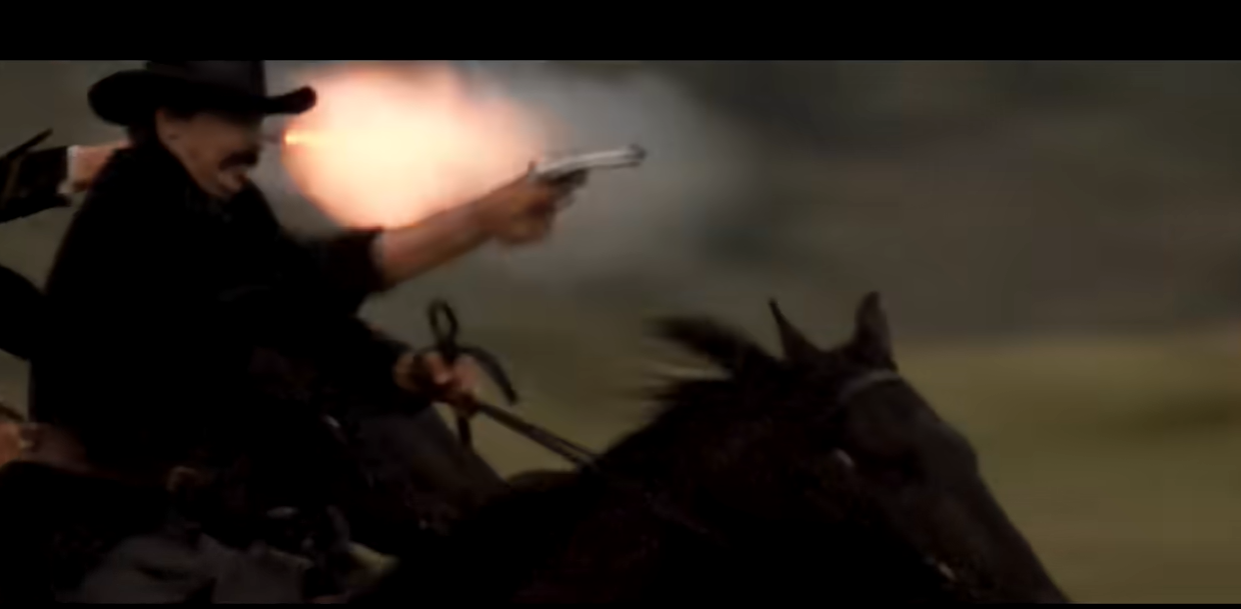
Kilmer understands that Doc Holliday is built from contradictions.
He is sick but fearless.
He is funny but deadly.
He is reckless with himself but fiercely loyal to his friends.
He appears weak but dominates almost every room he enters.
He seems detached from life, yet he cares deeply about the few people he allows close to him.
All of those contradictions come together in this confrontation.
That is what makes it feel like the moment Doc Holliday steals the movie.
Technically, Wyatt Earp is the central character of Tombstone. His journey drives the story. His family, his losses, and his revenge form the backbone of the narrative.
But when Doc walks out to face Johnny Ringo, the movie belongs to him.
For those few minutes, everything else disappears.
The audience is watching Val Kilmer.
His posture.
His eyes.
His voice.
His confidence.
And his complete lack of fear.
That kind of screen presence cannot be created with special effects.
It comes from performance.
The scene has also aged exceptionally well in the era of short-form video. It contains almost everything needed for a powerful 30-second or 60-second clip.
There is an immediate surprise.
There is a recognizable character.
There is verbal tension.
There is a psychological battle.
There is a quick payoff.
And most importantly, there is a personality strong enough to hold attention even when very little is happening physically.
That is why clips from Tombstone continue circulating decades after the film was released.
People are not only watching a Western gunfight.
They are watching confidence under pressure.
They are watching friendship expressed through action.
They are watching one dangerous man realize that he has finally encountered someone even more comfortable with death than he is.
And they are watching Val Kilmer deliver one of the defining performances of his career.
Many Western heroes are remembered for the moment they draw their gun.
Doc Holliday is remembered for everything he does before he draws it.
The smile.
The pause.
The quiet voice.
The absolute certainty.
By the time the bullet is fired, the audience already feels like the fight has been decided.
That is the brilliance of the scene.
Johnny Ringo arrives expecting a showdown with Wyatt Earp.
Instead, he finds Doc Holliday waiting for him.
And in that moment, Tombstone stops being only Wyatt’s story.
For a few unforgettable minutes, it becomes Doc’s movie.
