
“Semplicemente” is not just a song in Andrea Bocelli’s vast discography — it is a quiet declaration of who he is when the stage lights fade and the applause settles. In a career defined by grandeur, technical mastery, and global acclaim, this piece stands apart for its restraint. It does not reach for spectacle. It does not try to overwhelm. Instead, it invites the listener into something intimate, human, and profoundly sincere.
From the first notes, “Semplicemente” feels like a pause in time. Bocelli’s voice, instantly recognizable yet unusually tender here, carries a sense of reflection rather than performance. There is power, as always, but it is softened by vulnerability. This is not the voice of a man proving anything to the world. It is the voice of someone offering gratitude — for life, for love, and for the quiet bonds that endure beyond fame.
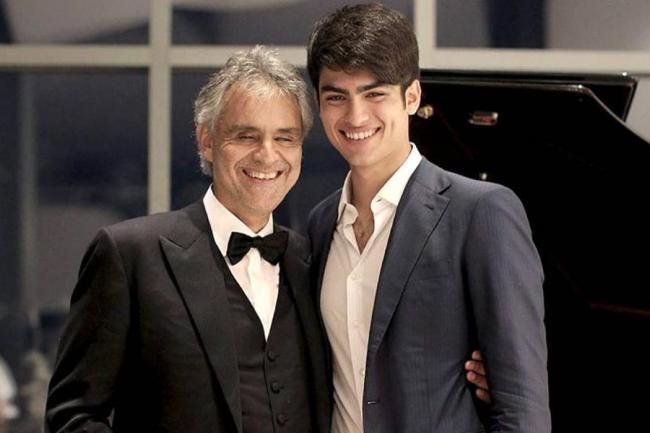
What makes the song especially moving is the presence of his sons, Amos and Matteo Bocelli. Their involvement transforms “Semplicemente” from a solo expression into a shared moment. This is not collaboration in the commercial sense, nor is it a symbolic gesture meant to impress. It feels organic, almost inevitable, as if the music had always been meant to be carried by more than one voice.
Amos Bocelli, often working behind the scenes as a pianist and composer, brings a sense of structure and emotional grounding to the piece. His musical contribution feels thoughtful and measured, supporting rather than competing with the melody. Matteo Bocelli, on the other hand, adds a youthful warmth — a voice that does not echo his father’s, but complements it. Together, their presence creates a layered emotional landscape: past, present, and future meeting within a single song.
Listening to “Semplicemente,” it becomes clear that the theme of simplicity is not accidental. The song does not rely on elaborate arrangements or dramatic shifts. Its strength lies in its honesty. Bocelli sings not about triumph, but about appreciation. Not about greatness, but about meaning. In doing so, he reminds listeners that the most powerful emotions are often the quietest ones.
This focus on simplicity feels especially significant coming from an artist whose life has been anything but ordinary. Andrea Bocelli’s journey — marked by blindness, discipline, and extraordinary success — could easily have produced music steeped in struggle or grandeur alone. Instead, “Semplicemente” turns inward. It suggests that after all the stages and standing ovations, what remains most valuable is connection.

The family dimension of the song deepens this message. Music, in the Bocelli household, is not treated as a performance first, but as a language. It is how emotions are shared, how generations speak to one another, how memory is preserved. When Andrea sings alongside his sons, there is no sense of hierarchy. The moment feels collaborative, equal, and deeply respectful.
This authenticity is what resonates so strongly with listeners. Fans often speak of feeling “close” to the Bocellis when hearing this song — as if they are not listening from afar, but sitting quietly nearby. The emotional transparency breaks down the distance that usually separates artist and audience. For a few minutes, fame disappears, and what remains is something universally familiar: a parent, children, and a shared expression of love.
“Semplicemente” also reflects a broader shift in how Andrea Bocelli has chosen to shape his legacy. Rather than guarding the spotlight, he shares it. Rather than defining success by dominance or singular achievement, he allows space for others — especially his family — to grow alongside him. This generosity is felt in the music itself. There is room to breathe, room to listen, room to feel.
The song’s message extends beyond the Bocelli family. It speaks to anyone who has felt overwhelmed by the noise of modern life, by constant ambition and expectation. “Semplicemente” offers a gentle reminder that joy does not always arrive through achievement. Sometimes it arrives through presence. Through listening. Through appreciating what is already there.

In this way, the song becomes almost philosophical. It asks the listener to reconsider what truly matters. Is it recognition, or connection? Is it complexity, or clarity? Bocelli does not answer these questions directly. He sings them into existence, allowing each listener to find their own meaning.
The warmth and authenticity brought by Amos and Matteo elevate the piece without ever distracting from its core. Their involvement feels less like an artistic choice and more like a natural extension of the song’s message. Family is not the subject alone — it is the medium through which the message is delivered.
As the final notes fade, “Semplicemente” leaves behind a lingering stillness. It does not demand applause. It invites reflection. Listeners are left with a sense of calm, perhaps even gratitude, for the simple relationships and moments that give life its depth.
In a world that often equates greatness with excess, Andrea Bocelli’s “Semplicemente” dares to suggest something else entirely. That meaning can be found in restraint. That love does not need to be loud. And that music, at its most powerful, does not impress — it connects.
More than a showcase of vocal mastery, this song is a reminder of why Bocelli’s voice has endured for decades. Not because of its range or technique alone, but because of its humanity. And with his sons beside him, that humanity feels fuller, richer, and unmistakably real.