“You Owe Me $200!” — The Brilliant Django Unchained Twist That Leaves an Entire Town Speechless
The Entire Town Wants Him Dead — But He Demands $200 Instead
Imagine shooting a sheriff in broad daylight, watching an entire town turn against you, and then calmly telling the authorities that they owe you money.
It sounds impossible.
But in Quentin Tarantino’s Django Unchained (2012), this extraordinary situation becomes one of the film’s most entertaining and cleverly constructed scenes.
After killing Sheriff Bill Sharp outside the saloon, Dr. King Schultz appears to have committed a crime that will almost certainly cost him his life.
The townspeople are horrified.
Armed deputies surround the building.
And U.S. Marshal Gill Tatum arrives determined to bring the apparent murderer to justice.
But Schultz is not afraid.
In fact, he has been waiting for precisely this opportunity.

What the marshal does not realize is that the dead sheriff has a secret identity.
And Schultz has the paperwork to prove it.
Surrounded by Guns With No Chance of Escape
The situation outside the saloon appears hopeless.
Armed lawmen have taken their positions, their weapons trained on the building.
Schultz and Django are trapped inside.
One wrong movement could trigger a deadly exchange of gunfire.
Yet Schultz refuses to panic.
Instead, he begins negotiating with Marshal Tatum.
He requests a guarantee that he and Django will not be shot immediately upon surrendering.
The marshal agrees to let them emerge.
Schultz then instructs Django to remain calm, avoid sudden movements, and allow him to handle the conversation.
This brief interaction reveals how their partnership is developing.
Django understands physical danger, but Schultz understands how to exploit the legal system.
Together, they step outside with their hands raised.
The whole town is watching.
Everyone expects an arrest.
But Schultz has something entirely different planned.
The Dead Sheriff Was Hiding an Incredible Secret

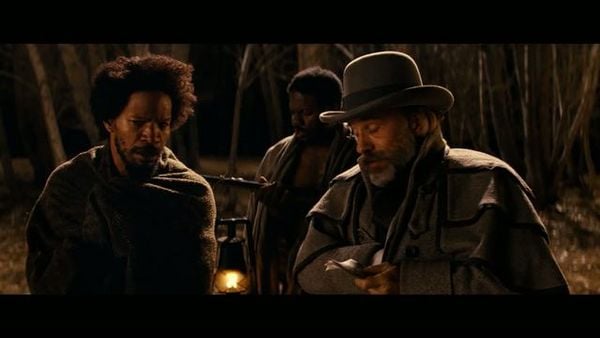
Standing before the marshal and his armed deputies, Schultz introduces himself as a man acting under the authority of the courts.
Then he delivers the revelation that changes everything.
The supposedly respectable Sheriff Bill Sharp was actually a wanted criminal named Willard Peck.
The man the townspeople had elected to enforce the law had previously been involved in cattle theft in Texas.
Even more astonishing, there was an outstanding bounty for his capture.
The reward was $200, dead or alive.
Suddenly, Schultz’s actions take on an entirely different meaning.
The mysterious stranger was not simply an outlaw who had murdered a sheriff.
He was a professional bounty hunter collecting a legally authorized reward.
And the sheriff was not the innocent lawman everyone believed him to be.
He was a fugitive living under an assumed identity.
The revelation leaves the marshal struggling to understand what has happened.
The entire power dynamic shifts in an instant.
One Piece of Paper Defeats a Crowd of Armed Men
Schultz has not arrived with an unsupported accusation.
He produces a warrant issued by Judge Henry Allen Laudermilk in Austin, Texas.
The document establishes the wanted man’s identity and provides the legal foundation for the bounty.
Schultz even encourages the marshal to verify the information directly with the judge.
This is what makes the encounter so memorable.

A moment earlier, dozens of weapons threatened Schultz and Django.
Now, a single legal document has undermined the entire confrontation.
The armed men cannot simply treat Schultz as a murderer without addressing the warrant he has presented.
Their confidence begins to disappear.
Tarantino uses the reversal to expose an uncomfortable truth about appearances and authority.
A badge does not automatically guarantee honesty.
An outsider is not automatically a criminal.
And the person who appears guilty may understand the law better than those attempting to enforce it.
Christoph Waltz Steals the Scene With One Final Demand
Christoph Waltz delivers Schultz’s explanation with extraordinary calm.
He sounds less like a man escaping a death sentence and more like a businessman explaining a perfectly legitimate transaction.
That contrast creates the scene’s dark humor.
The marshal expects to punish him.
Instead, Schultz concludes that he is entitled to collect his reward.
His final demand is almost absurdly simple: the marshal owes him $200.
For Django, the revelation is astonishing.
He has just witnessed a man kill a sheriff, confront an armed posse, and turn the entire encounter into a lawful bounty claim.
It is also an important lesson.
Schultz’s profession is dangerous, but it relies on knowledge, preparation, precision, and the ability to act decisively.
These are skills Django will increasingly need as his own journey develops.
Why This Scene Remains Unforgettable


The saloon sequence demonstrates several of Quentin Tarantino’s greatest storytelling strengths.
It begins with social tension, transforms into sudden violence, and concludes with an unexpected reversal.
Nothing unfolds quite as the audience initially expects.
The sequence also introduces the moral complexity of Schultz’s profession.
He kills for money, yet operates within a system of legal warrants.
He challenges racist conventions, yet remains a man capable of ruthless violence.
These contradictions make him a fascinating character rather than a conventional Western hero.
For Django, the encounter represents another step toward independence.
He begins to understand that freedom requires more than escaping physical captivity.
It also means learning how power works and finding ways to challenge those who possess it.
Final Thoughts: The Most Unexpected $200 Payday in the West

The genius of this confrontation lies in its simplicity.
A sheriff dies.
An entire town demands justice.
A marshal arrives with armed deputies.
And one calm bounty hunter reveals that the supposed victim was actually a wanted outlaw.
What looked like an act of murder becomes a legally authorized bounty killing within the film’s story.
Schultz doesn’t escape because he has the fastest gun. He escapes because he knows the truth before anyone else.
That unforgettable reversal is what makes this scene such a brilliant example of Tarantino’s signature combination of suspense, dark comedy, and explosive Western storytelling.
And for Django, it is only the beginning of a journey that will transform his life forever.
