He Escaped Civilization to Find Peace… But Lost Everything: The Tragic Legend of Jeremiah Johnson (1972)
He Wanted Nothing but Peace — Until the Mountains Took Everything
What happens when a man abandons civilization to find peace, only to discover that the wilderness can be even more unforgiving than the world he left behind?
That haunting question lies at the heart of Jeremiah Johnson (1972), one of the most powerful and emotionally complex Western films ever made.
Directed by Sydney Pollack and starring Robert Redford, the movie follows a former soldier who turns his back on society and ventures into the Rocky Mountains, hoping to build a new life far from conflict, expectations, and human cruelty.
But the freedom he seeks comes at a devastating price.
What begins as a breathtaking adventure of independence gradually transforms into a heartbreaking story of love, loss, vengeance, and survival.
Unlike traditional Western heroes who chase criminals or defend frontier towns, Jeremiah Johnson wants only to be left alone.
Unfortunately, the mountains have other plans.
A Former Soldier Walks Away From Civilization
Set around 1850, the story introduces Jeremiah Johnson, a former soldier who decides that civilized society has nothing more to offer him.
He heads into the mountains, determined to survive by hunting, trapping, and living off the land.
To Jeremiah, the wilderness represents freedom.
There are no commanding officers, crowded settlements, or social obligations.
Only endless forests, towering mountains, and the promise of solitude.
But freedom proves far more difficult than he imagined.
Jeremiah quickly discovers that surviving in the mountains requires more than determination.
The bitter cold, dangerous terrain, and constant struggle for food make his early experiences painfully difficult.
His lack of experience nearly defeats him before his new life has properly begun.
These early setbacks provide some of the film’s most memorable moments, blending humor with harsh realism.
Robert Redford portrays Jeremiah not as an invincible hero but as a stubborn, inexperienced man slowly learning to survive.
And his greatest lesson is still ahead.
Bear Claws Teaches Jeremiah the Rules of Survival
Jeremiah’s fortunes begin to change when he encounters Bear Claws Chris Lapp, an experienced mountain man played by Will Geer.
Rough, eccentric, and deeply knowledgeable, Bear Claws becomes an unlikely mentor.
He teaches Jeremiah essential survival skills, including hunting, dealing with dangerous wildlife, and adapting to the unforgiving mountain environment.
Their relationship adds warmth and humor to a story otherwise dominated by isolation.
Bear Claws understands something Jeremiah has yet to learn.
The wilderness does not reward arrogance.
It demands patience, knowledge, and respect.

Under his guidance, Jeremiah gradually becomes more capable and confident.
He learns to read the landscape, endure hardship, and survive conditions that would defeat most newcomers.
Yet the film never suggests that mastering nature makes a man its ruler.
Even the most experienced mountain dweller remains vulnerable.
This distinction becomes increasingly important as Jeremiah’s journey unfolds.
The Lonely Mountain Man Unexpectedly Finds a Family
Despite initially seeking isolation, Jeremiah discovers that meaningful human relationships are almost impossible to escape.
During his travels, he encounters a traumatized young boy whose family has been massacred.
The child, later known as Caleb, is unable to communicate normally after the horror he has witnessed.
Jeremiah takes him under his protection.
Their relationship develops quietly, through shared experiences rather than elaborate conversations.
The lonely mountain man unexpectedly becomes a father figure.
Later, Jeremiah encounters a Flathead chief and finds himself drawn into another relationship he never anticipated.
To avoid offending the chief and provoking conflict, he accepts marriage to the chief’s daughter, Swan, portrayed by Delle Bolton.
At first, the marriage is awkward.
Jeremiah and Swan come from different cultures and cannot communicate easily.
But their relationship gradually develops into genuine affection.
Together with Caleb, they form a small family.
For the first time, Jeremiah finds something he had not known he was searching for.
Not merely freedom from civilization, but a place where he belongs.
Their mountain home becomes a symbol of peace and emotional renewal.
Unfortunately, that happiness will not last.

One Decision Destroys the Peace He Worked So Hard to Build
The turning point comes when a group connected to the U.S. cavalry asks Jeremiah to guide a rescue expedition through the mountains.
The mission involves reaching stranded white settlers.
Jeremiah understands the dangers of the proposed route.
In particular, the expedition must pass through a burial ground sacred to the Crow people.
Such a violation carries serious consequences.
Jeremiah initially resists the pressure, recognizing that the territory should be respected.
But the urgency of the rescue mission eventually overrides his objections.
He leads the party through the forbidden ground.
The decision becomes the most devastating mistake of his life.
From Jeremiah’s perspective, he is helping save innocent people.
From the Crow perspective portrayed in the film, the expedition has violated a sacred place.
The consequences are catastrophic.
When Jeremiah returns home, he discovers that his wife and adopted son have been killed.
The family that gave meaning to his lonely existence has been destroyed.
In one heartbreaking moment, the peaceful life he spent years building disappears forever.
Grief Turns a Peaceful Man Into a Relentless Fighter
Jeremiah’s transformation following the deaths of his family is one of the most disturbing aspects of the film.
The man who fled civilization to escape violence now becomes consumed by it.
Grief hardens into anger.
Anger becomes a desire for revenge.
And revenge develops into a prolonged cycle of deadly confrontations.
Members of the Crow repeatedly challenge Jeremiah as the conflict grows into a personal vendetta.
Each encounter pushes him further away from the peaceful identity he originally sought.
His reputation spreads through the mountains.
He becomes a legendary fighter, feared and respected for his ability to survive seemingly impossible encounters.
Yet this reputation is deeply tragic.
Jeremiah has gained the strength and experience necessary to survive the wilderness, but he has lost the people who made survival meaningful.
The film presents his transformation with an uneasy mixture of admiration and sorrow.
He is an extraordinary survivor.
But he is also a broken man.

Robert Redford Delivers One of His Most Powerful Performances
Robert Redford’s performance gives Jeremiah Johnson much of its emotional impact.
Rather than relying on dramatic speeches, Redford communicates through restrained expressions, physical movement, and silence.
His character begins as an inexperienced outsider, becomes a capable mountain man, discovers love, and eventually suffers devastating grief.
Each stage feels like part of a believable human journey.
The film’s quiet moments are especially powerful.
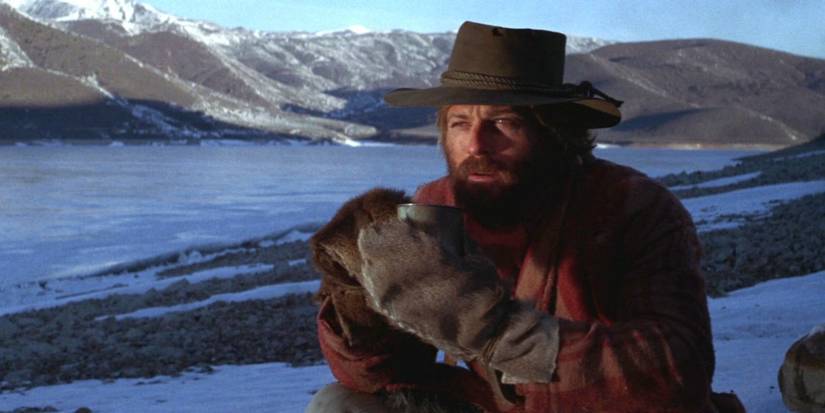
Jeremiah sitting alone in the wilderness can convey more emotion than an extended conversation.
His growing attachment to Caleb and Swan makes the later tragedy even more painful.
Redford allows viewers to recognize that Jeremiah’s greatest struggle is not merely against harsh weather or dangerous opponents.
It is against the emotional consequences of his own choices.
The Rocky Mountains Become a Character of Their Own
One of the movie’s greatest achievements is its spectacular landscape photography.
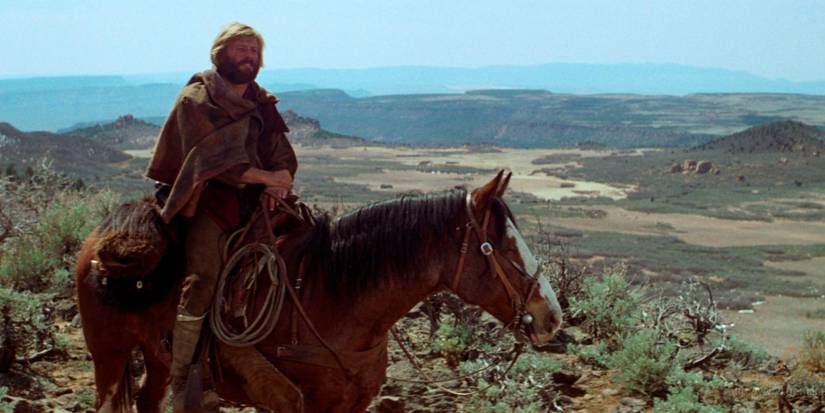
Filmed on location in Utah, Jeremiah Johnson captures the breathtaking beauty of the American wilderness.
Snow-covered mountains rise above endless forests.
Rivers cut through isolated valleys.
Winter storms transform the land into a dangerous world of ice and silence.
Sydney Pollack uses these locations to communicate both freedom and danger.
The mountains offer Jeremiah independence from society, but they also expose him to forces he cannot control.
Their beauty never disappears, even during the story’s darkest moments.
This contrast gives the film its haunting atmosphere.
Nature remains magnificent and indifferent, regardless of human happiness or suffering.
A Western That Challenged the Myth of the Frontier
Released in 1972, Jeremiah Johnson arrived during a period when Hollywood filmmakers were increasingly questioning traditional Western mythology.
The Vietnam War had contributed to a broader cultural reconsideration of violence, military authority, and American expansion.
Films such as Little Big Man (1970) and McCabe & Mrs. Miller (1971) challenged conventional ideas of heroic conquest and frontier civilization.
Jeremiah Johnson belongs to this revisionist tradition.
It questions whether escaping civilization truly allows anyone to escape its conflicts.
The film also portrays the destructive consequences of military intervention and violations of Indigenous territory.
At the same time, it remains complicated by its reliance on frontier mythology, particularly its portrayal of Jeremiah’s violent conflict with the Crow.
Rather than presenting an uncomplicated celebration of a heroic mountain man, the story exposes the contradictions within his legend.
Jeremiah achieves extraordinary independence, yet becomes trapped in a cycle of violence.
He seeks peace, but his reputation is built on killing.
He escapes society, only to discover that its conflicts have followed him into the wilderness.
The Final Encounter: A Moment of Grace After Years of Violence

Near the conclusion, Jeremiah encounters a Crow warrior whose presence recalls the long conflict that has defined his life.
After so much death, another violent confrontation seems inevitable.
But the moment takes an unexpected direction.
Instead of immediately attacking, the warrior raises his hand.
Jeremiah responds with the same gesture.
The exchange is quiet, simple, and profoundly meaningful.
For a man who has endured years of grief and vengeance, the gesture suggests the possibility of recognition and peace.
It does not erase the past.
It cannot restore his lost family.
But it allows the story to conclude with something other than another killing.
In a film filled with hardship, this brief moment of restraint becomes one of its most powerful statements.
Final Thoughts: The Man Who Found Freedom but Lost His World
Jeremiah Johnson (1972) is far more than a traditional Western adventure.
It is a deeply human story about a man who escapes civilization, discovers love in the wilderness, and then loses everything through a tragic collision of cultures and violence.
Robert Redford delivers an unforgettable performance, while Sydney Pollack transforms the spectacular mountain landscape into a setting for both freedom and sorrow.
The film’s enduring power comes from its central contradiction.
Jeremiah Johnson becomes a legend not because he finds the peace he desires, but because he survives after that peace has been destroyed.
His journey reminds viewers that the greatest battles are not always fought with guns.
Sometimes they take place within a person struggling to live with grief, regret, and the consequences of irreversible choices.
And that is why Jeremiah Johnson remains one of the most haunting and unforgettable Western films of its generation.
