Boardwalk Empire (2010): Power, Prohibition and the Price of Ambition
Boardwalk Empire (2010): Power, Prohibition and the Price of Ambition
Set against the glittering Atlantic City boardwalk of the 1920s, Boardwalk Empire turns the birth of Prohibition into a sweeping story about power, money and moral compromise. The HBO crime drama premiered in 2010, created by Terence Winter and executive-produced by Martin Scorsese. Steve Buscemi stars as Enoch “Nucky” Thompson, a political boss who stands at the centre of Atlantic City’s criminal world. The series was inspired by Nelson Johnson’s book about the city’s history and its notorious political machine.

The show begins as the United States enters the era of Prohibition, when the manufacture and sale of alcohol became illegal. In Atlantic City, the new law creates an opportunity for people willing to smuggle liquor, pay off officials and build influence through secret deals. Nucky is both a public figure and a criminal power broker, moving between hotels, political offices and back rooms where fortunes can change hands over a quiet conversation.
Rather than treating the period only as a backdrop for gangster action, Boardwalk Empire explores how politics, business and organized crime become intertwined. Nucky’s power depends on keeping those worlds connected. He must satisfy voters, protect allies, manage rivals and ensure that the illegal trade continues to bring money into his city. Each bargain comes with a cost, and each success creates new enemies.

Buscemi gives Nucky a distinctive presence. He is not a conventional screen gangster: he can appear courteous, controlled and almost paternal, but his calm manner conceals a practical willingness to use intimidation and violence. The character’s public image is part of his strategy. Nucky presents himself as a civic leader while quietly benefiting from the illegal economy flourishing around him. The tension between those roles gives the drama much of its force.

The series also develops a large ensemble of characters whose ambitions intersect with Nucky’s. Kelly Macdonald plays Margaret Schroeder, a woman who becomes entangled in his world while trying to secure a better future for herself and her family. Michael Pitt portrays Jimmy Darmody, a young veteran whose relationship with Nucky is shaped by loyalty, resentment and his own desire for influence. Michael Shannon plays federal agent Nelson Van Alden, a man whose rigid beliefs collide with the corrupt world he is assigned to police. HBO’s original material places Buscemi at the centre of the story and describes the wider setting as a city where Prohibition helps fuel organized crime.

The story’s historical atmosphere also allows it to bring real figures and fictional characters into the same landscape. Gangsters, politicians, police officers and bootleggers compete for territory and influence as the illegal liquor trade expands. The series uses these encounters to show how crime can become normalized when it is supported by money, political protection and public demand. The rules may change, but people with power often find ways to bend them.
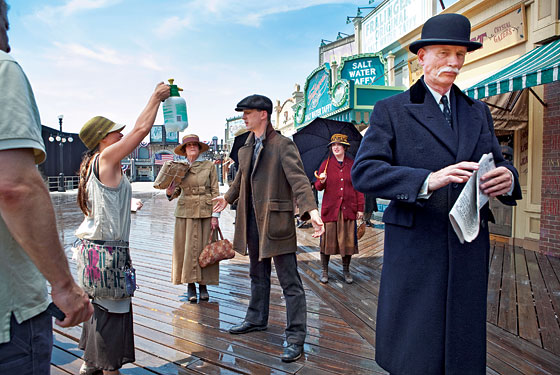
Atlantic City itself feels like a character in the drama. The boardwalk suggests entertainment, wealth and escape, while the rooms behind its bright façades reveal a more dangerous system. Hotels, clubs and political offices become meeting places where deals are made and loyalties tested. The contrast between spectacle and corruption gives the series a visual identity: the setting looks glamorous, but the promise of glamour is built on exploitation and risk.

That visual approach is supported by the production’s attention to period detail. Costumes, interiors and street scenes create a textured picture of a society changing quickly. The world feels carefully constructed without becoming merely decorative. The setting matters because the characters move through spaces shaped by class, political influence and access to money. A crowded street, a private dining room or a lavish hotel suite can each signal who holds control in a particular moment.
The series’ direction and writing bring a patient rhythm to the story. Conflicts often grow through conversations, pauses and shifting alliances rather than constant action. A character may seem to gain the advantage in one episode only to discover that the decision has made them vulnerable elsewhere. That slower build gives the criminal world a sense of scale. Nucky’s choices affect not just his own fortunes but also the people working for him, the political structure around him and the communities caught in the middle.

At the same time, Boardwalk Empire is not simply a portrait of criminal success. It repeatedly asks what ambition does to personal relationships. Characters who seek security or recognition often find themselves making compromises that deepen their isolation. Trust becomes difficult when affection can be used as leverage and when every alliance may be temporary. Even family ties are tested by the pressure to choose between loyalty and self-preservation.
The show’s five-season run allowed it to follow its characters through the changing landscape of Prohibition-era crime. The final season returned to Nucky’s earlier life while bringing the larger story toward its conclusion. HBO’s press materials describe the series as a drama about Nucky Thompson during a period when Prohibition helped drive the rise of organized crime in America.
Its craft received major industry recognition. The Television Academy lists Boardwalk Empire among the nominees for Outstanding Directing for a Drama Series, while HBO’s contemporary announcement reported that the series led its programming with eight Primetime Emmy wins in 2011. Those honours reflect the work across direction, design, cinematography and performance that helped establish the show’s distinctive period world.
More than a gangster story, Boardwalk Empire is a drama about systems of power and the people who learn to operate within them. Its central question is not only who will control the liquor trade, but what that control demands from everyone seeking a place in the hierarchy. With Buscemi’s carefully layered performance, a richly drawn ensemble and a vivid historical setting, the series offers a compelling look at a city where legality and morality rarely move in the same direction.
