Jeremiah Johnson (1972): He Walked Into the Wilderness Searching for Peace — But the Mountains Turned Him Into a Legend
Robert Redford delivered one of the most unforgettable performances in Western cinema as Jeremiah Johnson, a man who abandoned civilization to live freely in the Rocky Mountains, only to discover that survival demanded far more than courage, strength, or a rifle.
There are Western films built around legendary gunfighters, ruthless outlaws, and spectacular battles. Then there is Jeremiah Johnson (1972), a remarkable adventure that tells a very different story. Directed by Sydney Pollack and starring Robert Redford, the film follows a former soldier who ventures into the American wilderness seeking solitude and independence, only to encounter a world where nature is unforgiving, cultural misunderstandings carry deadly consequences, and even the strongest men cannot escape grief.

More than five decades after its release, Jeremiah Johnson remains a powerful example of the revisionist Western. Instead of glorifying conquest, the film examines the physical and emotional price of trying to live beyond the boundaries of society.
Its breathtaking mountain landscapes, restrained dialogue, and haunting atmosphere create an experience that feels both intimate and epic.
At the center of everything stands a man who believes the wilderness will give him peace. What he discovers instead changes him forever.
A Man Who Leaves Civilization Behind
Jeremiah Johnson begins his journey with an almost romantic idea of freedom. Tired of the civilized world, he heads into the Rocky Mountains determined to build a new existence as a mountain man.
He carries a rifle, basic supplies, and the conviction that independence is worth whatever hardship he might face.
But the mountains are indifferent to his ambitions.
In the early stages of his journey, Johnson struggles with the most fundamental requirements of survival. Hunting proves difficult, unfamiliar terrain repeatedly challenges his judgment, and freezing temperatures threaten to overwhelm him.
The wilderness that initially appeared beautiful and liberating becomes a constant reminder of his vulnerability.
This transformation is one of the film’s greatest strengths.
Rather than presenting Johnson as an invincible frontiersman from the beginning, Pollack allows audiences to witness his mistakes and gradual education.
Robert Redford’s performance emphasizes this evolution through subtle expressions and physical behavior. Johnson is determined, but often inexperienced. He possesses courage, yet courage alone cannot protect him from hunger, isolation, or the deadly realities of mountain life.
The film understands that becoming a survivor is not an achievement earned through a single dramatic confrontation. It is the result of repeated failures, observation, patience, and hard-earned experience.
The Wilderness Becomes His Greatest Teacher

As Johnson moves deeper into the mountains, he encounters individuals who have already adapted to life far beyond civilization.
Among the most important is Chris Lapp, known as Bear Claw, an eccentric and experienced mountain man played by Will Geer.
Bear Claw introduces Johnson to practical knowledge that no military training could fully provide.
Through their interactions, the film combines humor with an important lesson: surviving in the wilderness requires respecting the environment rather than attempting to dominate it.
Johnson gradually learns how to hunt effectively, recognize danger, endure harsh weather, and understand the rhythms of the natural world.
Their relationship also introduces warmth into an otherwise lonely story.
Bear Claw represents a different kind of wisdom from the authority Johnson left behind. His knowledge comes from experience rather than institutions, and his unusual personality reflects a life shaped by distance from conventional society.
These encounters help transform Johnson from an outsider into someone capable of navigating the mountains on his own terms.
Yet as his practical skills improve, his emotional journey becomes increasingly complicated.
He begins to discover that leaving civilization does not necessarily mean escaping human relationships.
Sometimes the wilderness brings people together in ways that are just as powerful as anything found in a town or settlement.
An Unexpected Family Changes Everything
One of the film’s most moving developments occurs when Johnson encounters a woman devastated by a violent attack that has destroyed her family.
He takes responsibility for her surviving son, a traumatized boy who no longer speaks.
The child, whom Johnson calls Caleb, becomes his companion, introducing an unexpected sense of responsibility into his previously solitary life.
Johnson later enters a marriage with Swan, a Flathead woman played by Delle Bolton, through an arrangement involving her family.
What begins as an unfamiliar and awkward household slowly develops into something meaningful.

These scenes reveal a gentler side of Johnson.
The hardened mountain traveler learns to communicate beyond words, share daily responsibilities, and appreciate the quiet happiness of belonging to a family.
For a man who originally abandoned society in pursuit of complete independence, this represents a profound transformation.
Johnson discovers that freedom does not always require loneliness.
Indeed, his most peaceful moments come not from isolation, but from the relationships he never expected to form.
The film takes its time establishing this happiness, making the events that follow considerably more devastating.
The Decision That Destroys His Peaceful Life
The tragedy at the center of Jeremiah Johnson emerges from a decision that initially appears practical.
When a military party requests his assistance in reaching stranded settlers, Johnson becomes involved in a dangerous journey through the mountains.
The route brings them near a Crow burial ground, a place holding profound spiritual significance.
Johnson understands that crossing this sacred territory risks provoking retaliation. However, the urgency of the military mission and pressure from the soldiers contribute to a decision that violates the burial ground.
That choice has catastrophic consequences.
The Crow retaliate against Johnson’s household while he is absent, killing Swan and Caleb.
When Johnson returns, he discovers that the family he had learned to love has been destroyed.
The emotional impact of this sequence comes from its restraint.
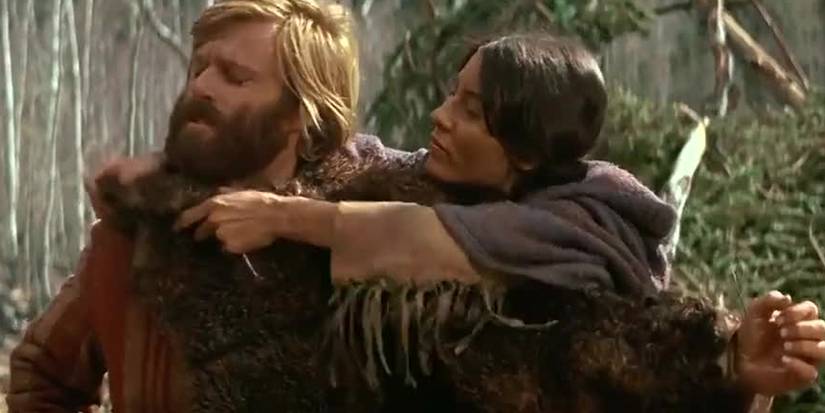
There is no triumphant speech, no comforting explanation, and no immediate restoration of justice.
Instead, Johnson confronts the unbearable reality that a decision made in the wilderness has cost him everything that mattered.
The tragedy also exposes the film’s broader historical tensions.
The American frontier was not empty territory waiting to be explored. It was home to Indigenous peoples with established cultures, sacred traditions, and relationships to the land.
Johnson’s personal tragedy unfolds within a larger history of conflict, intrusion, and cultural misunderstanding.
Although the film tells these events primarily from his perspective, their consequences complicate any simple division between heroes and villains.
When a Mountain Man Becomes a Feared Legend
Following the destruction of his family, Johnson’s character undergoes another transformation.
The man who originally sought a peaceful existence becomes consumed by grief and drawn into a prolonged conflict with Crow warriors.
His growing reputation is built through repeated encounters in which survival becomes inseparable from violence.
The quiet traveler who once struggled to hunt and endure winter now possesses the experience and determination of a formidable fighter.
Yet the film never fully presents this development as a victory.

Every confrontation reinforces his isolation.
Every successful act of survival reminds audiences of the life he has lost.
His growing legend becomes a tragic contradiction: the more feared and capable he becomes, the further he moves from the peace that originally brought him into the mountains.
Robert Redford communicates much of this transformation without elaborate dialogue.
His exhausted expressions, weathered appearance, and increasingly guarded movements convey the emotional burden Johnson carries.
Rather than becoming a conventional Western hero who conquers his enemies and returns to civilization, he becomes a figure almost inseparable from the unforgiving landscape around him.
His reputation grows, but his happiness does not return.
Robert Redford’s Performance Gives the Film Its Soul
One of the defining qualities of Jeremiah Johnson is its willingness to let images and silence communicate what dialogue cannot.
Redford portrays Johnson as an ordinary man gradually transformed by extraordinary circumstances.
His performance avoids constant displays of anger or exaggerated heroism.
Instead, the audience observes small changes in his behavior as survival, companionship, tragedy, and vengeance reshape his personality.
Sydney Pollack’s direction reinforces this approach.
The mountains are not simply scenic backgrounds for action sequences. They operate almost as another character, offering beauty, danger, isolation, and occasional refuge.
The cinematography captures enormous snowy landscapes, quiet forests, rushing rivers, and rocky valleys that make human ambition seem insignificant.
The film’s reflective musical score adds another layer of emotional weight, helping establish its melancholy tone without overwhelming the images.
These elements distinguish Jeremiah Johnson from Westerns built primarily around fast-paced gunfights and dramatic confrontations.
The story unfolds with patience, allowing the audience to experience the physical scale and emotional solitude of frontier life.
Its quieter moments often carry as much significance as its violent encounters.
The Ending Reveals the True Meaning of His Journey


The film’s final movement offers a resolution that is unusually restrained for a Western.
After years of conflict, Johnson encounters a Crow warrior who raises his hand in a gesture that suggests recognition and the possibility of peace.
Johnson eventually returns the gesture.
Rather than ending with another dramatic battle, the story closes on a moment of acknowledgment between men shaped by the same violent frontier.
It does not erase the deaths, suffering, or cultural conflict that preceded it.
Nor does it restore Johnson’s lost family.
But it suggests that even a long cycle of violence need not continue forever.
This quiet conclusion captures the film’s deepest theme.
Johnson entered the wilderness believing that freedom meant escaping humanity. He discovered companionship, suffered devastating loss, and became a legend through circumstances he never intended to create.
Ultimately, his journey becomes less about mastering the mountains than understanding the limits of violence and the price of isolation.
Jeremiah Johnson (1972) endures because it reminds audiences that the greatest Western stories are not always about the fastest gun or the strongest fighter. Sometimes they are about a man who wanted nothing more than a peaceful life — and the heartbreaking journey that followed when the world refused to let him have it.
