“You’re Men, Aren’t Ya?” — The Powerful Saloon Confrontation That Defines True Courage in the Old West
Kevin Costner and Robert Duvall deliver one of the most memorable moments in modern Western cinema, as two determined cowboys challenge a frightened town to stand against intimidation, corruption, and injustice.

The memorable “You’re Men, Aren’t Ya?” sequence captures that idea through a tense confrontation inside a crowded frontier saloon. With Robert Duvall portraying the experienced cattleman Boss Spearman and Costner playing the troubled gunslinger Charley Waite, the scene transforms an ordinary gathering of townspeople into a confrontation about fear, dignity, and the responsibility to resist tyranny.
Although the sequence contains little of the spectacular gunplay commonly associated with Western movies, its emotional intensity demonstrates why Open Range remains such a respected entry in the genre.
A Town Living Under the Shadow of Fear
The conflict in Open Range begins with a struggle over freedom and control.
Boss Spearman leads a small group of free-grazing cattlemen who believe in living independently on the open prairie. Their way of life brings them into conflict with Denton Baxter, a powerful rancher determined to eliminate competition and exercise control over the surrounding territory.
Baxter’s influence extends far beyond his own property. Through intimidation and connections with local law enforcement, he has created an environment in which ordinary citizens are afraid to challenge his authority.
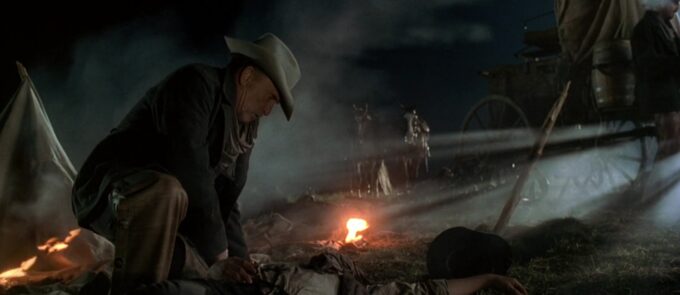
The violence against Boss’s men makes the conflict deeply personal. One member of their group is murdered, another is seriously injured, and the survivors realize that relying on the town’s compromised institutions will not bring justice.
Boss and Charley understand that they must eventually confront those responsible.
But before the inevitable showdown, they encounter another problem: the silence of the community.
The saloon scene reveals just how effectively fear has weakened the townspeople’s willingness to resist.

The sequence unfolds in a dimly lit frontier saloon, where smoke, wooden furnishings, cowboy hats, and crowded tables create an atmosphere of uneasy familiarity.
The room is filled with men who understand the danger surrounding their town. They know who holds power, they recognize the consequences of resistance, and they have learned to survive by avoiding confrontation.
When Boss and Charley enter this environment, their presence immediately changes its atmosphere.
The two cowboys are not politicians or professional revolutionaries. They are ordinary working men who have reached the limit of what they are willing to tolerate.
Their appearance reflects their circumstances. They are weathered, exhausted, and carrying the burden of recent violence.
Nevertheless, their determination is unmistakable.
Rather than deliver an elaborate speech, Boss confronts the townspeople with direct, uncomfortable questions about their willingness to act.
His challenge cuts through the excuses that have allowed Baxter’s control to continue.
The question, “You’re men, aren’t ya?” becomes the emotional centerpiece of the confrontation.
It is more than a demand for bravery. It challenges the men in the room to examine whether fear has caused them to surrender their responsibility to one another.
Robert Duvall Delivers a Lesson in Quiet Authority
Robert Duvall’s performance as Boss Spearman is essential to the scene’s impact.
Unlike the loud and aggressive figures commonly associated with Western confrontations, Boss rarely needs theatrical gestures to establish his authority.
His strength comes from experience, conviction, and an unwavering understanding of what he believes is right.
Throughout the film, Boss represents an older tradition of independence and personal responsibility. He is neither reckless nor eager for violence, but he refuses to accept a world in which powerful men can terrorize others without consequences.
Inside the saloon, that philosophy becomes impossible to ignore.
His voice carries the frustration of someone who has witnessed too much injustice to remain patient with excuses.
Yet Duvall avoids transforming the character into an exaggerated hero.
Boss remains recognizably human: tired, angry, and aware of the terrible risks ahead.
That combination makes his challenge powerful. He is not demanding something he is unwilling to do himself.
Instead, he is asking the townspeople to demonstrate the same courage that he and Charley are preparing to show.

Standing beside Boss is Charley Waite, one of the most psychologically complicated characters in Open Range.
Charley possesses a violent past that continues to shape his understanding of the world. Although he has attempted to leave that life behind, the escalating conflict with Baxter forces him to confront the skills and instincts he once hoped to escape.
Kevin Costner portrays Charley with restrained intensity.
He is a man of few words, but his silences reveal extraordinary emotional depth. His expressions suggest someone constantly measuring the danger around him while struggling to control the darker aspects of his personality.
In the saloon, Charley’s presence reinforces Boss’s challenge.
He understands that the townspeople are frightened. He also understands that avoiding violence does not necessarily prevent it.
Sometimes, he recognizes, refusing to act merely gives violent individuals more freedom to harm others.
This understanding creates an important contrast between Charley and the men around him.
Charley has seen what violence can do, and he does not romanticize it. Nevertheless, he knows that there are moments when standing aside becomes its own form of moral failure.
His quiet determination makes the approaching confrontation feel both inevitable and tragic.
The Meaning Behind “You’re Men, Aren’t Ya?”
The famous line carries a significance that extends beyond the traditional masculine codes of Western films.
On the surface, Boss is challenging the courage of the men gathered in the saloon.
But beneath that challenge lies a broader question about civic responsibility.
What happens to a community when decent people allow fear to dictate every decision?
In the film, Baxter’s power depends partly upon the unwillingness of ordinary citizens to oppose him.
His authority is sustained not merely through physical force, but through the belief that resistance is hopeless.
Boss attempts to break that belief.
By confronting the townspeople directly, he forces them to recognize that their collective strength may be greater than they imagine.
The scene suggests that courage is not necessarily the absence of fear. Rather, it is the willingness to act despite understanding the consequences.
That distinction gives the sequence its emotional resonance.
The townspeople do not suddenly become fearless heroes. Their hesitation remains understandable, especially given the real danger posed by Baxter and his men.
But Boss’s words expose the cost of continued submission.
The choice before them is no longer simply between safety and danger. It is between accepting injustice and attempting to reclaim control over their community.

Kevin Costner directs the scene with patience and remarkable attention to atmosphere.
Instead of relying on rapid editing or dramatic action, he allows tension to build through dialogue, facial expressions, and the positioning of characters within the crowded room.
The subdued lighting gives the saloon a heavy, almost claustrophobic quality.
Although the room contains numerous people, there is a distinct feeling of isolation surrounding Boss and Charley.
They are confronting not only Baxter’s influence, but also the reluctance of those who might otherwise support them.
The camera repeatedly emphasizes the reactions of individual townspeople, revealing uncertainty, frustration, and unease.
These details make the confrontation believable.
Costner understands that powerful dramatic moments do not always require elaborate visual spectacle. Sometimes, a single uncomfortable question can generate greater tension than an exchange of gunfire.
The scene also benefits from the film’s naturalistic approach to Western dialogue.
The characters speak with the bluntness of working men whose lives have been shaped by hardship and physical labor.
Their words carry weight precisely because they are not overly polished.
The Calm Before an Explosive Showdown
One of the most effective aspects of the saloon confrontation is its placement within the larger story.
By this point, the conflict with Baxter has escalated beyond the possibility of an easy resolution.
Boss and Charley recognize that a violent reckoning may be unavoidable.
The saloon scene therefore operates as a moment of moral preparation.
Before confronting their enemies, the two cowboys confront the community’s willingness to tolerate oppression.
This gives the eventual gunfight additional significance.
The coming violence is not presented merely as an opportunity for the heroes to demonstrate their shooting abilities. It becomes part of a struggle over the kind of society the town will allow to exist.
The sequence also clarifies the bond between Boss and Charley.
Their friendship is built upon shared hardship, mutual loyalty, and an understanding that some principles are worth defending regardless of personal danger.
When they stand together inside the saloon, that relationship becomes visible without requiring an explicit declaration.
Why This Scene Still Resonates

More than two decades after its release, Open Range continues to stand out for its grounded characters, deliberate pacing, and emotionally convincing depiction of frontier life.
The “You’re Men, Aren’t Ya?” sequence embodies those strengths.
Robert Duvall gives Boss Spearman a sense of dignity that comes from experience rather than arrogance. Kevin Costner portrays Charley Waite as a haunted man trying to use his dangerous abilities for a worthwhile purpose.
Together, they transform a tense conversation into a statement about freedom, responsibility, and moral courage.
The scene reminds viewers that injustice does not always survive because villains are exceptionally powerful. Sometimes it survives because everyone else has become convinced that resistance is impossible.
Boss challenges that assumption with a few direct words.
His question demands more than an answer. It demands a decision.
In the end, Open Range argues that real courage is not measured by how loudly someone speaks or how quickly they draw a weapon.
It is measured by what they are willing to defend when the consequences become real.
And in that smoky frontier saloon, two cowboys remind an entire town that dignity is worth standing up for.
