The Most Ridiculous Western Showdown Ever — When a Deadly Gunfight Turns Into a Hilarious Disaster
In the dangerous world of the American Old West, a gunfight was supposed to be the ultimate test of courage, skill, and reputation. Two men would face each other beneath the blazing sun, townspeople would gather in nervous anticipation, and only one gunslinger would walk away victorious. But in A Million Ways to Die in the West (2014), director Seth MacFarlane transforms this classic Western tradition into something completely unexpected: a confrontation so outrageously ridiculous that it destroys nearly every heroic convention associated with cowboy movies.
The film’s unforgettable “Sh*tty Showdown” scene perfectly demonstrates MacFarlane’s particular brand of comedy. What initially appears to be a serious confrontation in the middle of a dusty frontier town quickly becomes an absurd spectacle involving humiliation, physical discomfort, and a spectacular failure of traditional Western masculinity.
Rather than celebrating the fearless gunslinger, the sequence exposes how vulnerable, foolish, and embarrassingly human even the most intimidating men can become.
A Classic Western Street Becomes the Stage for Disaster
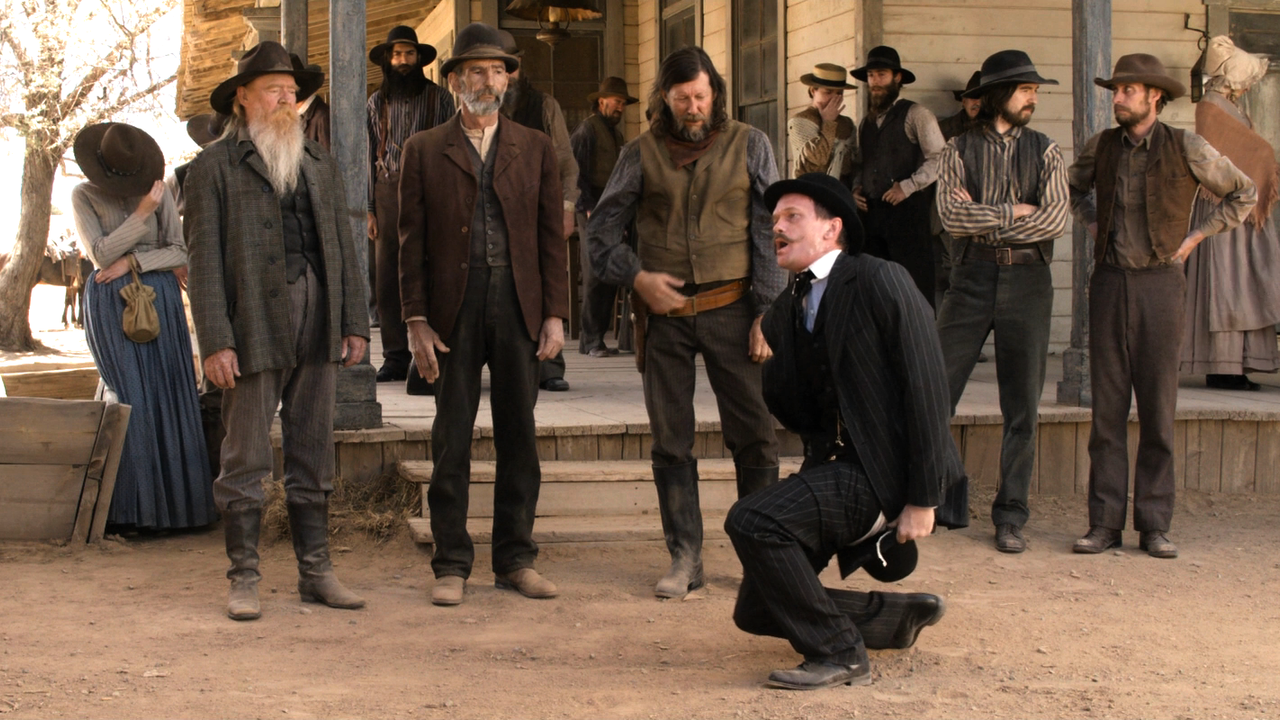
The scene opens with the familiar visual language of an old-fashioned Western.
A dusty street stretches between wooden buildings, with townspeople gathering outside storefronts to witness what promises to be a dramatic confrontation. Cowboys stand watching, their expressions suggesting that something dangerous is about to happen.
The atmosphere resembles countless classic Western films in which two men prepare to settle their differences through violence.
But the central figure, Albert Stark, played by Seth MacFarlane, is far removed from the fearless heroes traditionally associated with the genre.
Albert is an ordinary sheep farmer whose defining characteristic is his absolute awareness of how terrifyingly dangerous life in the Old West can be.
He has little interest in becoming a legendary gunfighter. He understands that surviving another day is often more important than protecting one’s pride.
This perspective makes Albert fundamentally different from the characters portrayed by traditional Western icons.
Where a conventional cowboy hero might confidently reach for his revolver, Albert is more likely to question why anyone would willingly participate in such a suicidal ritual.
And in this particular sequence, his instincts about the absurdity of frontier life prove especially appropriate.
The Most Unexpected Weapon in a Western Showdown
The confrontation involves Foy, portrayed by Neil Patrick Harris, a wealthy and arrogant businessman whose elaborate appearance and theatrical personality already distinguish him from the rugged gunfighters surrounding him.
Foy has built his identity around wealth, social superiority, and an exaggerated sense of personal importance.
He is precisely the sort of man who wants to appear powerful in front of a crowd.
But his carefully cultivated reputation begins to collapse when his own body turns against him.
Instead of delivering the confident display of intimidation expected from a Western antagonist, Foy becomes overwhelmed by an embarrassing physical emergency.
The situation transforms the traditional gunfight into an escalating exercise in humiliation.
As the townspeople watch, Foy struggles to maintain his composure.
His movements become increasingly awkward, his expression shifts from confidence to distress, and his attempt to preserve even a small amount of dignity becomes hopeless.
The comedy emerges from the contrast between how the confrontation should unfold and what actually happens.
A man who entered the encounter hoping to demonstrate superiority finds himself fighting an entirely different battle.
And unlike the gunfights portrayed in classic Westerns, this is not a confrontation that can be resolved through quick reflexes or accurate shooting.
Neil Patrick Harris Steals the Scene


One of the principal reasons the sequence works so effectively is Neil Patrick Harris’s willingness to embrace the character’s complete humiliation.
Known for his sharp comedic timing and polished screen presence, Harris plays Foy with an exaggerated self-confidence that makes his eventual embarrassment even funnier.
His performance combines theatrical facial expressions, physical comedy, and a remarkable commitment to the scene’s deliberately crude humor.
At first, Foy attempts to maintain the appearance of control.
But as his predicament grows increasingly desperate, that confidence disappears.
His movements become frantic, and the sophisticated businessman suddenly looks like someone whose greatest ambition is simply to escape public attention.
The surrounding crowd makes matters worse.
Instead of experiencing his humiliation privately, Foy must endure it in the middle of a street filled with witnesses.
Every awkward movement is visible.
Every failed attempt to recover his dignity makes the situation more ridiculous.
Harris plays the escalation without trying to make his character appear sympathetic or heroic. His willingness to look thoroughly foolish becomes the foundation of the sequence’s humor.
The result is a performance that turns a relatively simple bodily-function gag into a prolonged comic spectacle.
Seth MacFarlane Turns Western Tradition Upside Down
As both director and leading actor, Seth MacFarlane approaches the Western genre with an unusual combination of affection and irreverence.
The movie clearly recognizes the visual appeal of traditional cowboy cinema.
Its wide landscapes, wooden frontier towns, period costumes, and dramatic confrontations are presented with the production values of a genuine Western.
But MacFarlane consistently uses those familiar elements to undermine the mythology surrounding the Old West.
The “Sh*tty Showdown” sequence is an especially effective example.
A traditional Western confrontation generally reinforces the idea that courage, masculinity, and deadly skill determine a man’s status.
Here, those qualities become almost irrelevant.
Foy’s money cannot protect him.
His expensive clothing cannot preserve his dignity.
His reputation cannot rescue him from the humiliating situation unfolding in front of the entire town.
Meanwhile, Albert’s unconventional approach to conflict challenges the assumption that physical bravery is always the most effective solution.
Instead of glorifying violence, the scene encourages audiences to laugh at the absurd social expectations that make these confrontations possible.
The frontier may be dangerous, but its inhabitants are often their own worst enemies.
Physical Comedy Meets Old-Fashioned Western Satire


The film’s humor frequently relies on the collision between modern comedic sensibilities and historical Western settings.
In this sequence, physical comedy plays a particularly important role.
The audience does not need an elaborate explanation to understand Foy’s predicament.
His posture, facial expressions, and increasingly desperate movements communicate the disaster immediately.
The reaction of the surrounding townspeople adds another layer of humor.
Their presence transforms an intensely personal embarrassment into a public spectacle.
The scene also benefits from its deliberate pacing.
Rather than rushing directly toward the punchline, it allows Foy’s discomfort to escalate.
Each attempt to recover control seems to make the situation worse.
This structure resembles classic slapstick comedy, where the audience anticipates an inevitable disaster long before the character can escape it.
Yet MacFarlane places that familiar comedic formula inside a setting traditionally associated with heroic violence.
The resulting contrast makes the humor more distinctive.
What should be a moment of legendary Western confrontation instead becomes an unforgettable exercise in public embarrassment.
A Western Comedy That Refuses to Take Itself Seriously
Released in 2014, A Million Ways to Die in the West features an ensemble cast including Seth MacFarlane, Charlize Theron, Amanda Seyfried, Liam Neeson, Giovanni Ribisi, Sarah Silverman, and Neil Patrick Harris.
The story follows Albert Stark as he struggles to survive in a frontier environment where danger appears around practically every corner.
After losing his girlfriend, Albert develops a connection with Anna, a mysterious woman who helps him confront his fears and become more confident.
Unfortunately, Anna’s connection to a dangerous outlaw brings Albert into a conflict far beyond his usual experience.
The film uses this central storyline as a foundation for numerous comedic situations involving frontier medicine, violent crime, romantic jealousy, and the everyday absurdities of nineteenth-century life.
Some jokes depend on verbal wit, while others embrace deliberately outrageous physical comedy.
The “Sh*tty Showdown” sequence belongs firmly in the second category.
Its humor is crude, exaggerated, and intentionally uncomfortable.
But it also reflects the film’s larger argument: life in the Old West was not necessarily the glorious adventure depicted in romanticized cowboy legends.
Sometimes, survival depended less on courage than on avoiding the next ridiculous disaster.
Why This Ridiculous Showdown Remains Memorable

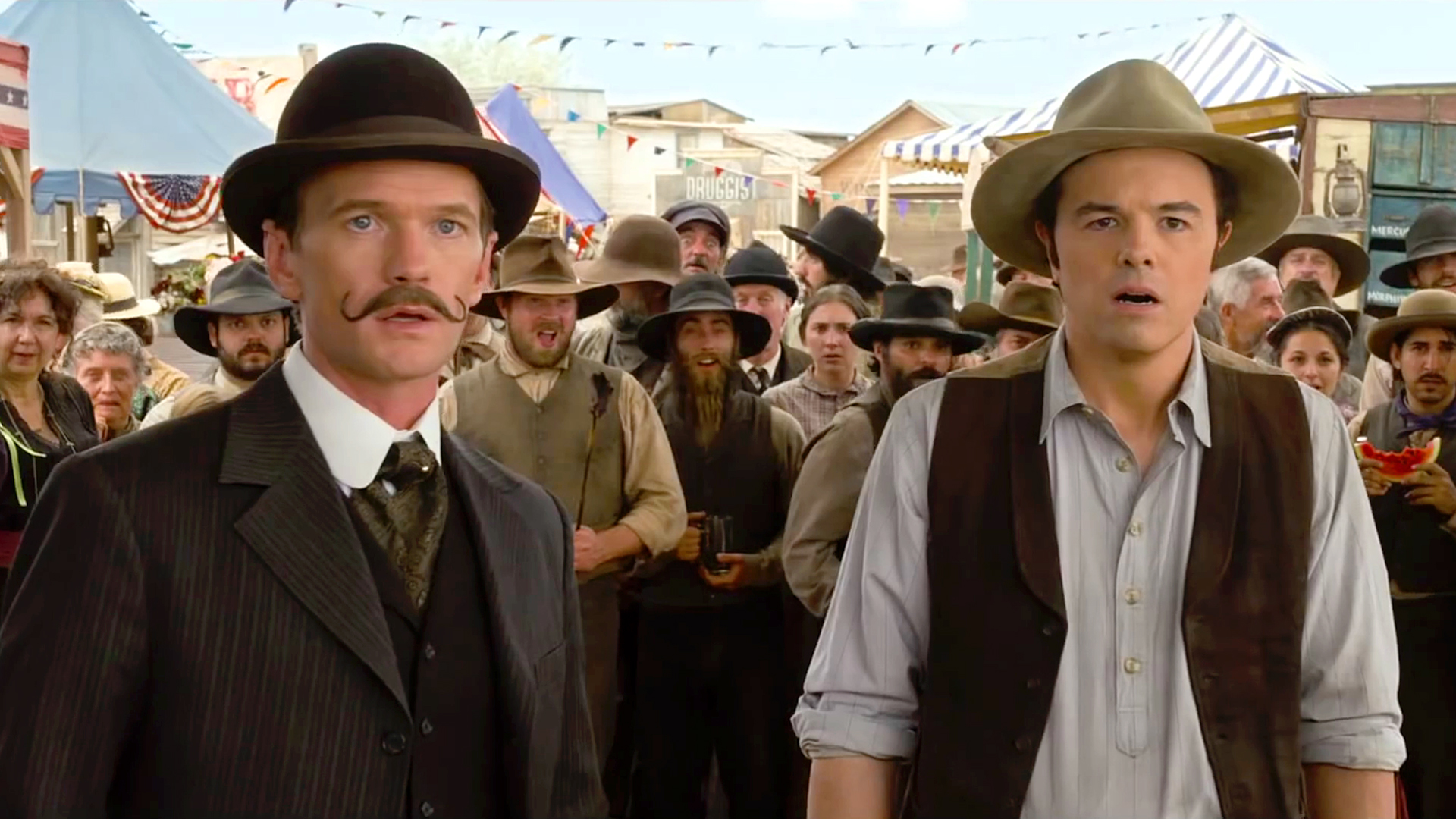
There is something especially satisfying about watching a character who considers himself superior lose control in the most embarrassing way imaginable.
Foy begins as a man determined to project confidence and dominance.
By the end of the confrontation, that carefully constructed image has been completely destroyed.
The transformation happens without the kind of triumphant gunfire normally associated with Western confrontations.
Instead, physical comedy becomes the instrument of humiliation.
For viewers who enjoy the genre’s familiar conventions, the scene offers a playful reversal of expectations.
For audiences who appreciate Seth MacFarlane’s unapologetically crude humor, it delivers precisely the kind of outrageous spectacle the filmmaker is known for.
And for Neil Patrick Harris, it provides an opportunity to turn an arrogant supporting character into the center of one of the film’s most absurd comedic moments.
The sequence also highlights the importance of contrast in effective comedy.
The more seriously the setting presents itself, the more ridiculous Foy’s behavior becomes.
The dusty street, the anxious witnesses, and the expectation of a dramatic gunfight all contribute to a punchline that depends on destroying the audience’s assumptions.
Ultimately, A Million Ways to Die in the West reminds viewers that not every confrontation in cowboy country ends with a heroic victory or a tragic death.
Sometimes the most humiliating defeat has absolutely nothing to do with a revolver.
And in this unforgettable showdown, the most dangerous thing on the frontier isn’t a loaded gun — it’s a man’s complete inability to control his own body.
