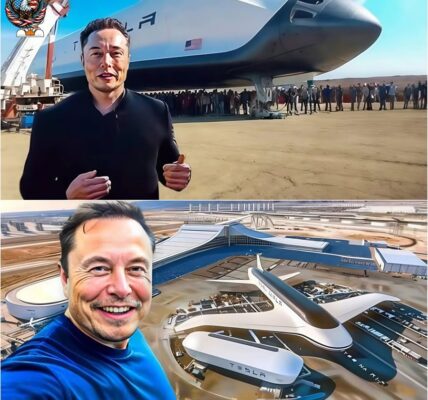

Elon Musk is more than a billionaire entrepreneur. His name has become a symbol of audacity, relentless curiosity, and the refusal to accept limits imposed by convention. In a world where most people are taught to dream carefully, Elon Musk dreams dangerously — pushing ideas so far beyond the norm that they initially seem impossible, unrealistic, or even absurd.
Yet time and again, those same ideas reshape industries, redefine technology, and alter humanity’s trajectory.
From electric vehicles to reusable rockets, from artificial intelligence to the ambition of colonizing Mars, Musk’s life reads like science fiction unfolding in real time. But unlike fiction, his story is built on risk, failure, obsession, and an unwavering belief that the future can be engineered.
A Mind Wired for the Impossible
What sets Elon Musk apart is not simply intelligence or wealth. It is the way his mind approaches problems. Musk doesn’t ask, “What is reasonable?” He asks, “What is physically possible?”
This principle — often referred to as first-principles thinking — strips problems down to their fundamental truths and rebuilds solutions from scratch. It’s the reason he challenged industries that had remained unchanged for decades.
When experts said electric cars would never be practical, Musk built Tesla.
When space travel was deemed too expensive for private companies, he founded SpaceX.
When reusable rockets were dismissed as fantasy, he made them land themselves.
Each time, skepticism followed. And each time, he moved forward anyway.
Reinventing Transportation on Earth
Tesla began as a risky experiment in a niche market. Electric cars were slow, unattractive, and unreliable. Traditional automakers dismissed them as toys.
Musk saw something else: a future where clean energy was not a compromise, but an upgrade.
Tesla didn’t just build electric vehicles. It redefined what a car could be — fast, software-driven, constantly evolving through updates. Autonomous driving, over-the-air upgrades, and minimalist design weren’t afterthoughts; they were central to Musk’s vision.
Today, Tesla is no longer just a car company. It is a technology platform reshaping transportation, energy storage, and artificial intelligence.
Conquering the Final Frontier
If Tesla changed how we move on Earth, SpaceX changed how we leave it.
Before SpaceX, space travel was slow, costly, and controlled almost entirely by governments. Launches were rare, expensive, and disposable — rockets were used once and discarded.
Musk saw inefficiency where others saw inevitability.
SpaceX’s reusable rockets transformed the economics of spaceflight. By landing boosters vertically and reusing them, the cost of reaching orbit dropped dramatically. What once took decades of government planning could now be done faster, cheaper, and more frequently.
But Musk’s ambition goes far beyond orbit.

Mars is not a metaphor for him. It is a destination.
He believes humanity must become a multiplanetary species to survive long-term risks — from climate disasters to cosmic threats. Starship, the most powerful rocket ever built, exists for that singular purpose.
To Musk, Mars is not science fiction. It is a logistical challenge.
Artificial Intelligence and the Future of Humanity
Musk’s relationship with artificial intelligence is complex. While he invests heavily in AI through companies like Tesla and xAI, he has also been one of its most vocal critics.
He warns that AI, if left unchecked, could surpass human control — not out of malice, but indifference. This dual perspective makes him unusual: a builder who is deeply aware of what he is unleashing.
Rather than rejecting AI, Musk advocates for understanding it, guiding it, and integrating it responsibly. He believes humanity must evolve alongside its creations — intellectually and ethically.
Fearless Doesn’t Mean Fearless of Failure
Despite the myth of effortless genius, Musk’s journey is filled with failure.
Rockets exploded. Companies nearly went bankrupt. Public criticism was relentless. In 2008, both Tesla and SpaceX were hours away from collapse.
What defines Musk is not the absence of fear — but his willingness to proceed despite it.
He reinvested his last remaining money. He slept on factory floors. He absorbed pressure that would have crushed most people.
Failure, to him, was never a verdict. It was data.
A Vision That Comes at a Cost
Musk’s intensity has a price. Long hours, relentless stress, and public scrutiny have taken a toll on his personal life. He has spoken openly about loneliness, insomnia, and emotional exhaustion.
Yet he continues — not because it is easy, but because the vision is bigger than comfort.
This is the paradox of Elon Musk: the same drive that builds the future also isolates him from the present.
Why Elon Musk Matters
Elon Musk is not important because he is rich. He is important because he forces the world to reconsider what is possible.
He challenges complacency.
He disrupts stagnation.
He reminds humanity that progress is not automatic — it must be pursued.
In an age of incremental improvement, Musk believes in leaps. In a time of cautious optimism, he insists on bold ambition.
Beyond the Stars
Elon Musk’s story is far from over. His projects remain controversial. His timelines remain aggressive. His personality remains polarizing.
But one truth is undeniable: he dares to dream at a scale few others attempt.
While many ask what is realistic, Musk asks what is necessary.
And in doing so, he pushes humanity — not just toward better technology — but toward a bigger imagination of its own future.
Beyond Earth.
Beyond limits.
Beyond the stars.
https://www.youtube.com/watcht/S1CHX6Oj1Yo