
The Viña del Mar International Song Festival has never lacked icons. For decades, its stage has welcomed voices that defined generations, artists who arrived with spectacle, precision, and rehearsed perfection. Viña knows what a great performance looks like. The crowd knows when to cheer, when to demand an encore, when to crown a star. But every once in a while, something happens that doesn’t follow the script. Something that can’t be planned, rehearsed, or repeated. And when Matteo Bocelli walked onto that stage, that was exactly the kind of night it became.
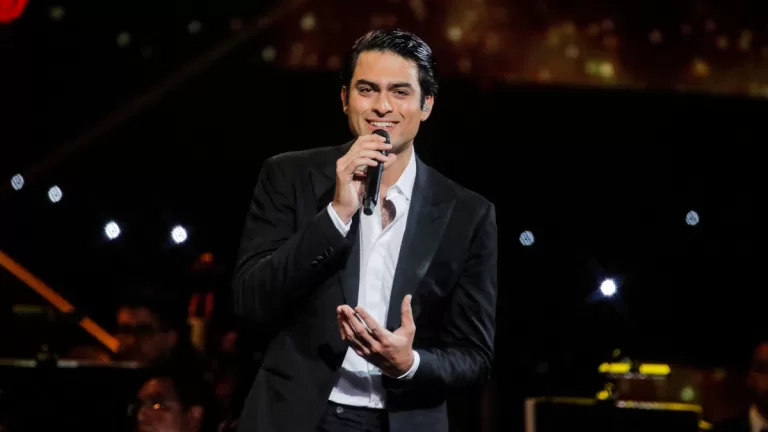
From the moment the first notes of “Quando, Quando, Quando” filled the air, there was a subtle shift in the crowd. Not explosive. Not dramatic. Just a collective leaning forward. Phones that had been raised out of habit slowly lowered. Smiles replaced anticipation. People weren’t waiting to be impressed anymore—they were simply listening.
Matteo’s voice carried warmth rather than force. Confidence without arrogance. It wasn’t trying to conquer the festival; it was inviting it in. Each phrase flowed effortlessly, grounded in classical training but colored with something deeply human. This wasn’t a young artist trying to prove himself under the weight of a famous last name. This was someone fully present in his own skin.
Viña audiences are famously demanding. They applaud loudly, but they also withhold approval when something feels hollow. That night, there was no doubt. The connection was immediate and undeniable. You could feel it in the stillness between lines, in the way the crowd seemed to breathe with him rather than over him. “Quando, Quando, Quando” became less of a song and more of a conversation unfolding in real time.
Then came the moment no one expected.
Without any dramatic cue or grand gesture, Matteo stepped away from the microphone stand. He didn’t signal the band. He didn’t hype the crowd. He simply moved—down the steps, off the stage, and into the audience. Not as a performer seeking attention, but as a human following instinct.
There was no rush. No security scramble. No forced choreography. Just Matteo, walking among the people who had come to see him, meeting their eyes, smiling softly, letting the song breathe differently now that it belonged to everyone in the space. Fans reached out, not in frenzy, but in disbelief. Some laughed. Some sang along. Some stood frozen, unsure if the moment was real.
And Matteo let them sing.
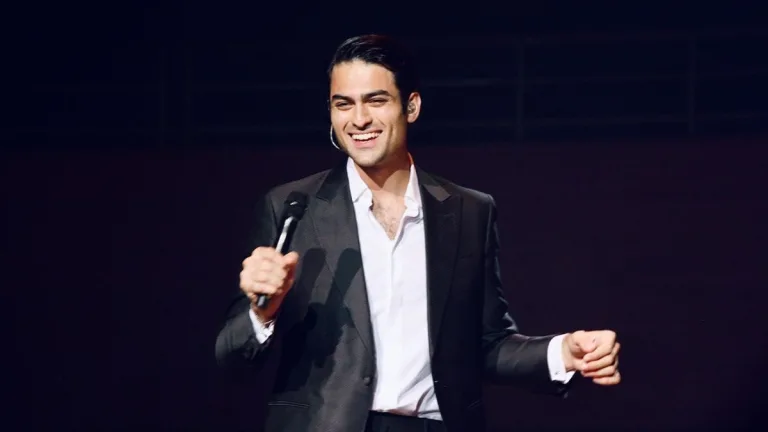
He didn’t overpower their voices. He didn’t reclaim control. He listened. He danced lightly with the rhythm of the crowd, swaying with strangers who would remember that moment for the rest of their lives. In that instant, the distance between stage and audience disappeared. There was no hierarchy—no “star” and “spectator.” Only shared sound, shared emotion, shared presence.
For a festival built on spectacle, this quiet intimacy felt revolutionary.
People often talk about legacy when they talk about Matteo Bocelli. About lineage. About expectation. About what it means to be Andrea Bocelli’s son. But nights like this reveal something far more important: Matteo isn’t trying to inherit a throne. He’s building his own space—one defined not by comparison, but by connection.
There was something profoundly modern about that choice. In an era of overproduction, viral moments engineered for clips and clicks, Matteo did the opposite. He slowed everything down. He trusted the room. He trusted the music. And most of all, he trusted the people standing in front of him.
As the song continued, the crowd grew braver. Voices rose louder. Spanish accents blended with Italian melody. Laughter spilled between lyrics. It didn’t matter who sang perfectly and who didn’t. Perfection wasn’t the point. Presence was.
By the time Matteo returned to the stage, something irreversible had happened. The performance could end, but the memory was already sealed. People weren’t cheering just because they’d witnessed a good song. They were cheering because they’d been part of it.
Viña has seen legends arrive in limousines, wrapped in lights and expectation. It has seen artists dominate the stage with power and precision. But this night felt different because it wasn’t about dominance at all. It was about openness. Vulnerability. The quiet courage to step closer instead of standing above.
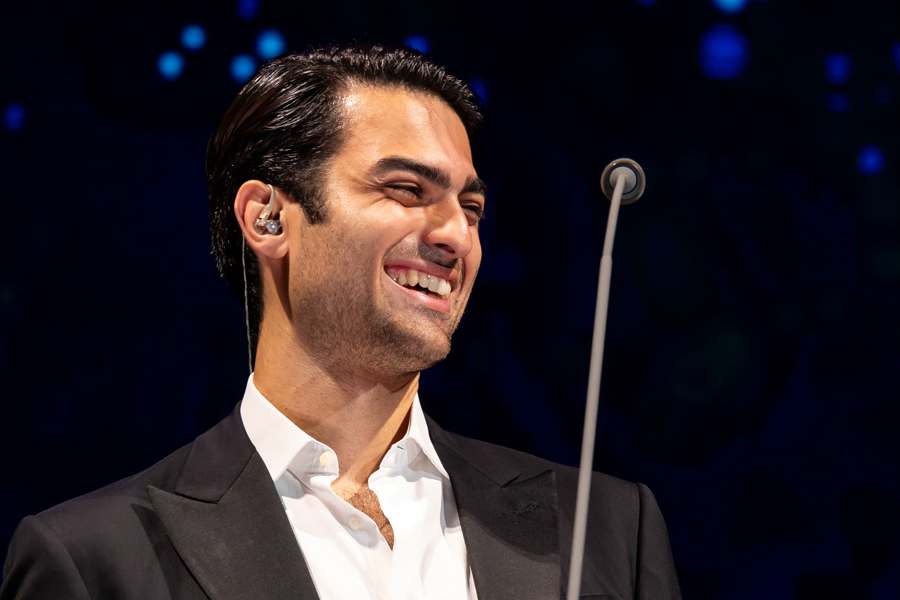
When the final notes faded, the applause wasn’t explosive—it was deep. Sustained. Grateful. The kind of applause that says, We felt that. We’ll carry it with us.
For Matteo Bocelli, Viña wasn’t just another stop on a tour. It was a reminder—and a declaration. That music doesn’t always need to be louder to be unforgettable. Sometimes, it just needs to be shared.
And everyone who stood in that crowd knew one thing for certain as they left the arena that night: they hadn’t just watched a performance.
They had lived a moment.