Adam Sandler’s Hilarious and Honest Reflection: Imagining a Life Without Acting at the Palm Springs Film Awards

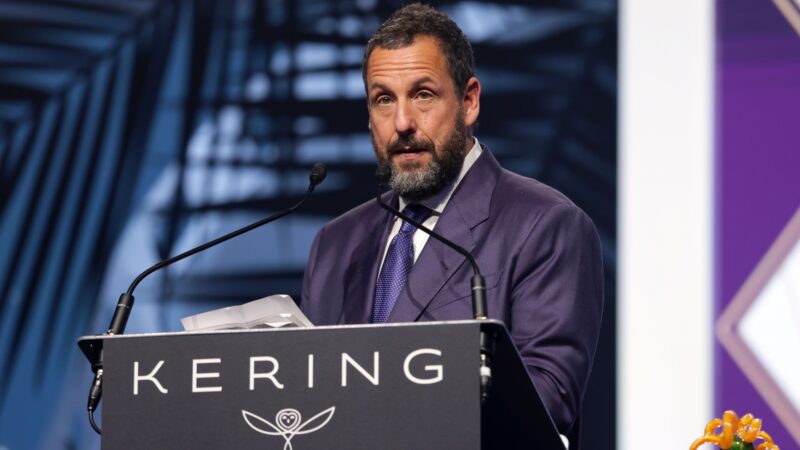
When Adam Sandler stepped onto the stage to accept the Chairman’s Award at the Palm Springs International Film Awards, the audience expected laughter. What they didn’t expect was a moment that was equally funny, honest, and quietly profound.
Rather than delivering a traditional thank-you speech filled with polished gratitude, Sandler did what he has always done best: he told a story — one rooted in self-deprecating humor, family, and the unpredictable nature of chasing a dream.
That night, Sandler invited everyone to imagine an alternate version of his life — a version where he never became an actor.
“Like every actor,” he began, “when I decided to become an actor, my parents were disgusted.”
The room erupted in laughter, but the truth behind the joke was instantly recognizable. Sandler explained that when he graduated college with a Bachelor of Fine Arts, his father reacted not with dreams of Hollywood glory, but with practical concern. His dad, an electrical contractor, offered a deal that many parents would consider generous and realistic:
Try acting for one year.

If it doesn’t work, come work with me.
Sandler admitted he didn’t know much about electricity, wiring, or contracting. But the offer represented something deeper — a safety net, built not on fame or money, but on family support.
That one-year gamble, as the world now knows, changed everything.
But Sandler didn’t dwell on success. Instead, he asked a question that few celebrities dare to ask publicly:
“What if I had quit?”
He painted an absurdly vivid picture of the life he might have lived had he taken his father up on that offer.
“We’d definitely have a different house,” he joked. “Probably ten fewer bathrooms and a few less statues of me.”
The audience laughed again, but the joke carried an undertone of humility. Sandler wasn’t mocking a simpler life — he was acknowledging how random and fragile success can be.
In this imagined alternate reality, Sandler suggested he might finally know how to charge his own phone — a playful jab at his dependence on others in his current life. He joked that he’d still be stopped on the street for photos, not because of fame, but because people had “never seen anybody with that much scoliosis.”
The jokes kept coming, each more ridiculous than the last. But woven through them was something deeply human: gratitude.
Sandler imagined that even in this other life, he’d somehow still be friends with Rob Schneider, joking that he’d probably have Schneider working with him on every electrical contracting project. It was a small line that drew big laughs, but it also highlighted something Sandler is known for — his loyalty.
In Hollywood, where friendships often fade with success, Sandler has famously kept the same circle of collaborators for decades. Whether he was a struggling comedian or a global movie star, the people around him remained the same.
He went on to describe how vacations would look very different in this alternate universe. No Hawaiian beaches. No luxury resorts. If he wanted to swim, he’d go to the pond near the nuclear power plant down the street.
“But it’s not all bad news,” he added. “Because then my p*nis would glow in the dark.”
The room lost it.
Yet even that outrageous punchline served a purpose: it reminded everyone why Adam Sandler has endured. His humor isn’t polished or pretentious. It’s messy, personal, and unapologetically human.
Sandler joked that he’d still be wearing the same clothes he always wears — a nod to his famously casual style — and closed with perhaps the most self-aware line of the night:
“I’d probably still have a deal with Netflix… but I’d be paying them a monthly fee.”
Behind the laughter, Sandler’s speech quietly underscored something powerful: success is never guaranteed. His career wasn’t the result of a master plan, but of taking a chance — supported by family, shaped by failure, and sustained by authenticity.
By imagining a life without acting, Adam Sandler wasn’t expressing regret. He was expressing perspective.
He honored his parents.
He honored the version of himself that almost didn’t make it.
And he reminded the audience that even the biggest careers are built on fragile beginnings and one-year promises.
In an industry obsessed with image, Adam Sandler stood onstage and did something rare. He laughed at himself. He honored his roots. And he reminded everyone that the most meaningful success stories are often just one “try it for a year” away from never happening at all.
And somehow, he made all of that hilarious.