
Myles Garrett Didn’t Blink — And Why That Moment Resonated
When a viral narrative celebrated Myles Garrett for forcefully condemning Donald Trump’s alleged racism, its rapid spread wasn’t driven solely by partisan alignment. It tapped into something deeper: a cultural hunger for moral clarity in a political environment many experience as evasive, strategic, and ethically ambiguous. The moment mattered not just for what was said, but for how it was framed—and why audiences were ready to receive it.
At the center of the story is a transformation. Garrett is not presented as a politician or a tactician weighing costs and benefits. He is framed as a truth-teller—someone willing to articulate what many feel but hesitate to say. In this telling, political speech becomes moral testimony rather than institutional debate. Supporters read his refusal to soften language as courage, a rejection of the caution that often dilutes ethical confrontation into procedural neutrality and emotional distance.
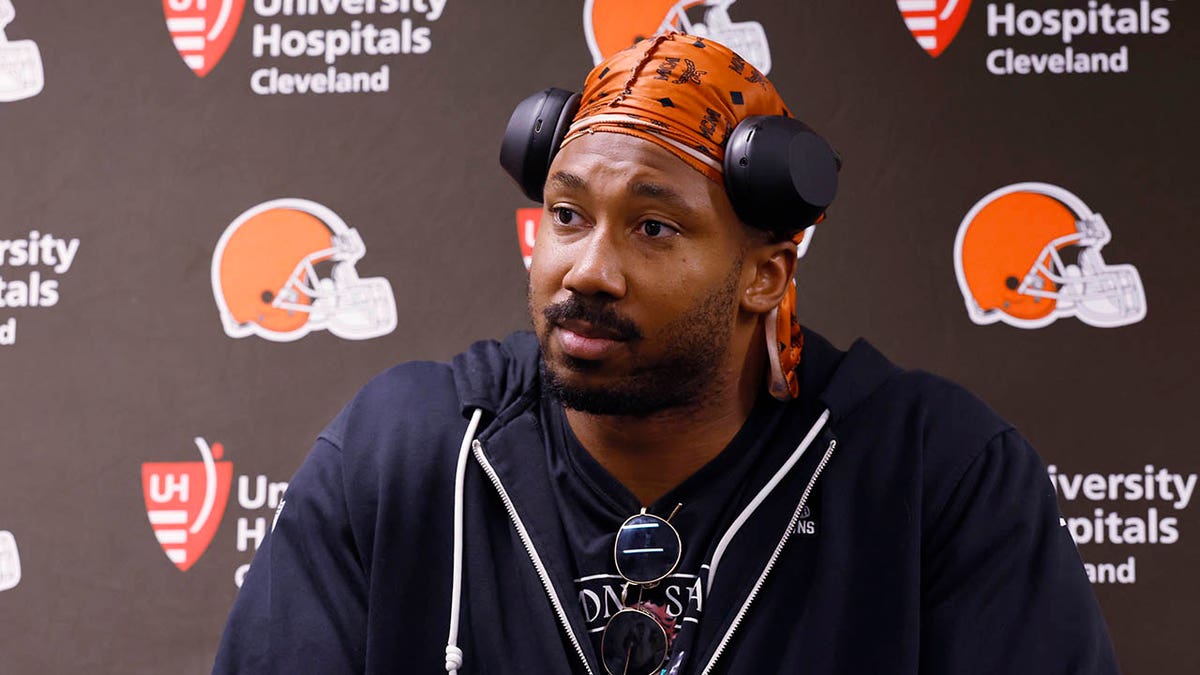
That framing elevates Garrett into a symbolic role. He is cast as someone who cuts through euphemism, political calculation, and institutional inertia to name perceived injustice directly and without apology. The symbolism is powerful because it responds to a widespread frustration with “politics as usual,” which many feel prioritizes managing perception over confronting harm, and survival within systems over accountability to those affected by them.
In this narrative, speech itself becomes action. Language is treated not as a prelude to policy or negotiation, but as a form of resistance and moral intervention. This reflects a broader cultural shift in which statements, symbols, and stories are seen as politically meaningful—sometimes even more meaningful than legislation or governance. Saying the right thing publicly becomes a form of power; refusing to say it becomes a form of complicity.
The emotional impact intensifies through historical framing. Garrett’s words are presented not as a single opinion, but as part of a larger moral arc, suggesting continuity with past controversies and a pattern of behavior. Patterns feel more meaningful than moments because they imply intention and character rather than accident or misunderstanding. That cumulative framing reduces ambiguity and increases moral certainty.
Moral certainty, in turn, is emotionally satisfying. In a time defined by complexity and contested truths, clarity offers comfort. It allows people to locate themselves on the side of justice without navigating nuance or conflicting interpretations. But that same clarity can be polarizing. When disagreement is recast as immorality and alternative readings as denial, space for dialogue shrinks. Complexity becomes suspect; calls for nuance are read as excuses.
The phrase “he didn’t blink” is telling. It frames emotional restraint and unwavering certainty as moral strength, suggesting that doubt signals weakness or compromise. This valorization of certainty reflects a cultural moment that prizes decisiveness and firmness—even when such clarity is constructed through selective emphasis. The risk is that conviction outruns accuracy, and emotional coherence eclipses contextual complexity.
In the digital age, narratives that feel true often travel faster than those that are painstakingly verified. Social media environments reward emotional intensity, moral clarity, and identity affirmation. Algorithms amplify content that provokes strong reactions, whether outrage or celebration. Stories like this thrive because they match the emotional grammar of the platform: intensity equals visibility; certainty equals shareability.
This dynamic reveals changing expectations of leadership. Authenticity is increasingly defined as emotional alignment rather than factual precision. Courage becomes rhetorical boldness rather than practical effectiveness. Leaders are evaluated less by outcomes than by how they speak, with speech acting as a proxy for moral worth. Politics, in this sense, becomes as much performance and storytelling as governance.
The appeal is understandable. In a world marked by inequality, injustice, and historical trauma, many feel ordinary political processes have failed to deliver dignity or fairness. Moral speech offers recognition and validation to those who feel unheard. It signals that someone is naming harm and refusing silence—and that recognition matters.
Yet there is a danger when moral theater substitutes for structural change. Strong statements can provide emotional relief while leaving underlying systems intact. Validation without reflection can harden into self-confirmation rather than collective understanding. The challenge for democratic culture is to make room for moral speech without letting it foreclose complexity, conversation, or the possibility of transformation through engagement.

Ultimately, the story’s power lies less in its factual claims than in its symbolism. It mirrors a society wrestling with how to confront power, how to speak about harm, and how to balance moral urgency with democratic humility. It invites us to ask not only whether a statement is brave, but what it builds, what it heals, and what it changes over time. In that sense, the moment is not a conclusion—it’s a reflection of what people want politics to feel like, and an open question about what it must become to deliver lasting justice.