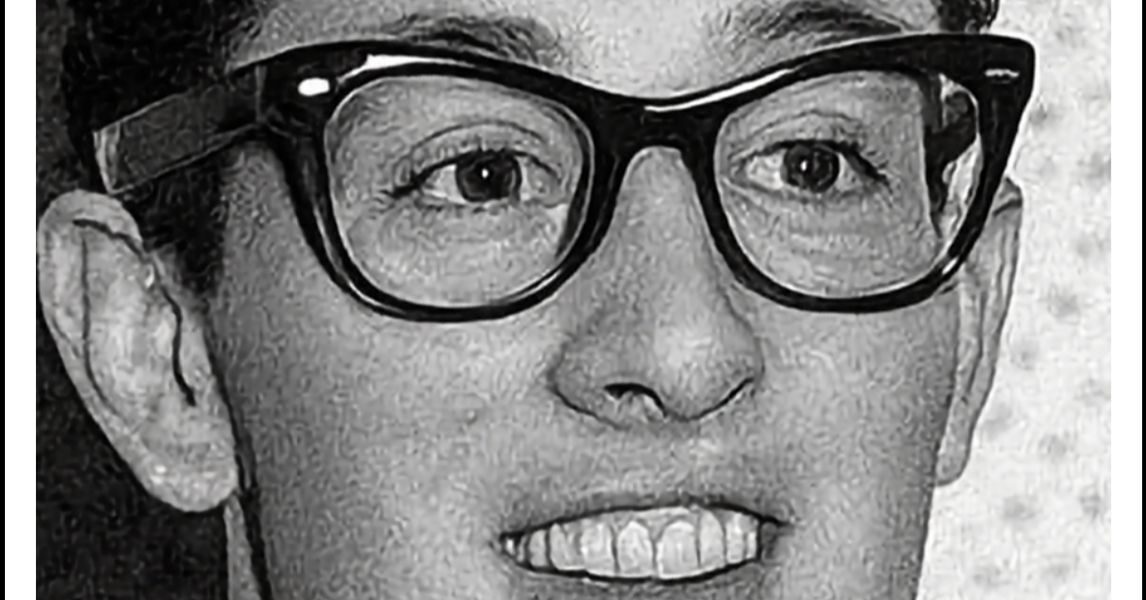
Did you know this heartbreaking detail about Buddy Holly’s final days? When the plane went down on February 3rd, 1959, Buddy’s wife, María Elena, didn’t hear the news from the police… she heard it on TV.

The Day Rock ’n’ Roll Fell Silent
February 3rd, 1959, is remembered as “The Day the Music Died.”
On that frozen Iowa night, a small plane carrying Buddy Holly, Ritchie Valens, and J.P. “The Big Bopper” Richardson crashed shortly after takeoff, killing everyone on board. The news sent shockwaves through the music world, cutting short the life of a 22-year-old artist who had already changed the course of modern music.
But while history often focuses on the legends lost in the crash, it rarely lingers on the quiet devastation left behind — especially the pain experienced by the woman Buddy Holly loved most.

2. The News That Should Never Have Come From a Screen
When the plane went down, Buddy Holly’s wife, María Elena Holly, did not receive a knock at the door.
No police officer arrived.
No official notification was made.
Instead, she learned of her husband’s death the same way millions of strangers did — by watching television.
Imagine the moment:
A young woman, newly married, pregnant, alone — suddenly confronted with a breaking news announcement that shattered her world without warning, without preparation, without compassion.
That single failure would change her life forever.
3. A Loss That Multiplied Overnight
María Elena was pregnant at the time of Buddy’s death. The shock of learning about the crash in such a sudden, impersonal way proved overwhelming. Shortly afterward, she suffered a miscarriage.
In a matter of days, she lost her husband, her future child, and the life she had just begun to build.
It was grief stacked upon grief — the kind of pain history books rarely pause to acknowledge.
4. The Human Cost Behind the Headlines
Buddy Holly was already a legend in the making.
He had reshaped songwriting, studio production, and the sound of rock ’n’ roll itself. Artists for decades to come — from The Beatles to Bob Dylan — would cite him as a defining influence.
But to María Elena, he wasn’t a pioneer or an icon.
He was her husband.
They had been married for less than six months.
Their story was still in its opening chapter when it was violently cut short.
5. A Tragedy That Changed How Death Is Reported
The mishandling of Buddy Holly’s death notification led to lasting consequences beyond one family. In the aftermath, policies were changed regarding how authorities inform next of kin about fatalities — particularly in high-profile cases.
María Elena’s experience became a quiet catalyst for reform, ensuring that future families would not learn about unimaginable loss from a television screen.
Her pain, though deeply personal, reshaped procedure in ways that protected others.
6. Grief Lived Away From the Spotlight
For decades, María Elena Holly carried her grief privately. She never sought sympathy through spectacle. Instead, she dedicated herself to preserving Buddy’s legacy — protecting his music, his image, and his artistic vision.
She became not only his widow, but also his guardian in history.
Through her efforts, Buddy Holly remained more than a tragic ending. He remained a voice, a force, and a future that continues to echo.

7. Remembering the People Behind the Legend
It’s easy to mythologize figures like Buddy Holly — to freeze them in time as immortal symbols of talent and youth. But stories like this remind us of something essential:
Behind every legend is a human life.
Behind every hit song is a family.
Behind every headline is real pain.
Buddy Holly’s final days weren’t just the end of a career. They were the beginning of a lifelong grief for someone who loved him not as a star — but as a man.
8. Why This Story Still Matters
This lesser-known chapter of rock ’n’ roll history isn’t just about tragedy. It’s about empathy. About responsibility. About remembering that fame does not shield loved ones from suffering.
The music lived on.
The legend grew.
But the cost was real — and it was paid quietly.
And perhaps that is the most heartbreaking truth of all.