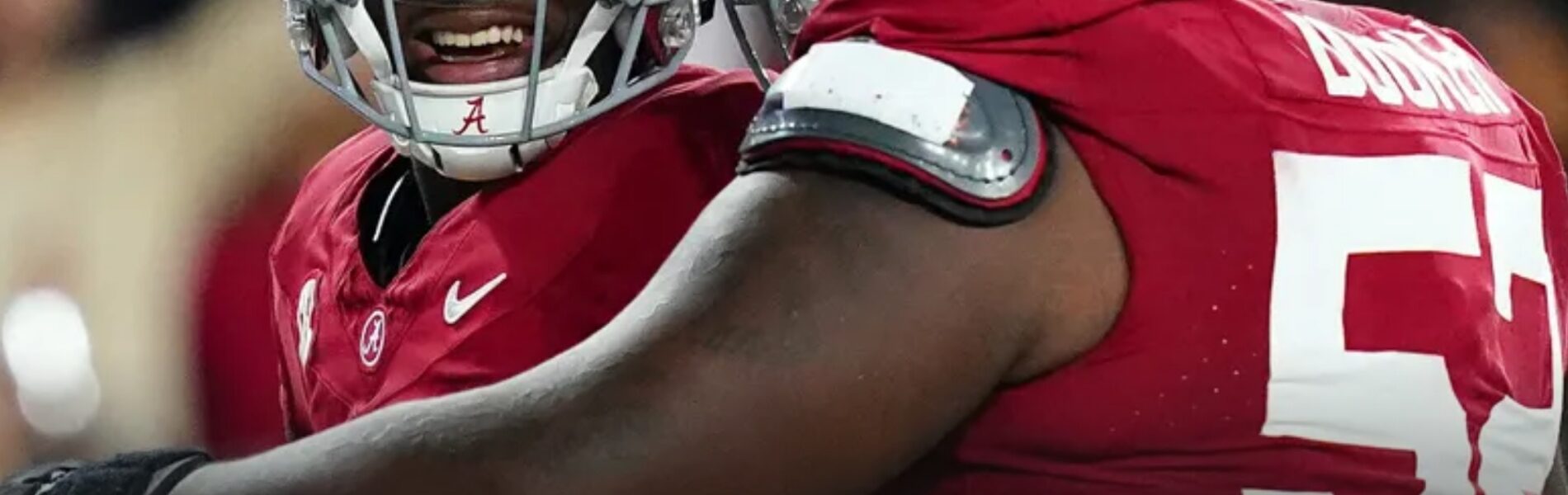
BREAKING: Two more Alabama defensive starters are expected to skip the NFL draft and return to the Tide.

Former Alabama basketball player Charles Bediako sued the NCAA in a Tuscaloosa court Tuesday, arguing for a temporary restraining order and preliminary injunction that would allow him to play this season for the Tide.
Bediako played two seasons for Alabama from 2021-23 before entering the NBA draft. The 7-foot center later played in the NBA G-League, and is currently a member of the Motor City Cruise. He has averaged 14.7 minutes per game, 5.2 points and 5.1 rebounds per game in the G-League this season. He most recently played five minutes of a Saturday game against the Birmingham Squadron.
Bediako, 23, has enrolled at Alabama for the spring semester, per his court filing. The NCAA denied Alabama’s request to grant Bediako eligibility to play this season, according to the filing.
“Official regular season games for the University of Alabama’s 2025-2026 men’s basketball season have already begun and the team has already started conference play within the Southeastern Conference,” Bediako’s attorneys wrote in the filing. “Mr. Bediako will be irreparably harmed if he is not able to join the team immediately because of the lost development and opportunity to become integrated with his teammates and potentially participate in a postseason run.”
Attorney Darren Heitner, who has represented several athletes in cases against the NCAA, is listed as one of Bediako’s attorneys. Bediako averaged 6.6 points per game, 5.2 rebounds per game and 1.7 blocks per game in two seasons with Alabama.
NCAA president Charlie Baker released a statement Tuesday evening after the lawsuit was filed.
“The NCAA is aware of media reports about a lawsuit filed against the NCAA by Charles Bediako,” Baker said. “Mr. Bediako signed three NBA contracts after competing in college for two seasons. The NCAA has not and will not grant eligibility to any prospective or returning student-athletes who have signed an NBA contract. Eligibility rules ensure high school students get a shot at earning scholarships, and we will continue to consistently apply and defend these rules.”
Bediako, a native of Canada and four-star prospect in the 2021 high school class, last played for Alabama in a Sweet 16 loss to San Diego State in the 2023 NCAA tournament. He entered the 2023 NBA draft with two seasons of college eligibility remaining, but went undrafted and signed a two-way contract with the San Antonio Spurs. He then played for the G-League’s Austin Spurs, Grand Rapids Gold and the Cruise — playing for the latter two teams under Exhibit 10 contracts with the Denver Nuggets and Detroit Pistons, respectively.
The NCAA ruled in September that former G-League Ignite player Thierry Darlan was eligible to play for Santa Clara University, and in October former G-League Ignite player London Johnson committed to Louisville. The NCAA cleared both players, drawing criticism at the time from longtime Michigan State coach Tom Izzo and Arkansas coach John Calipari.
Baker issued a statement in December clarifying the organization would not grant eligibility to players who signed two-way NBA contracts like Bediako, but some G-League players were paid for only “actual and necessary expenses” that keep them eligible.
Alabama coach Nate Oats earlier this month addressed the topic of teams and professional players taking advantage of recent court rulings to return to play in college.
“You kind of have to, if they’re eligible and somebody else is going to get them,” Oats told SiriusXM College Sports Radio on January 5. “I wouldn’t say that I’d be one of the guys that was necessarily for it to begin with, because I think it’s taking away opportunities from kids coming out of high school. I was a high school coach for 11 years. I wanted my kids to get opportunities when they left my program. This is taking opportunities away from those kids.
“But on a competitive level, if it’s allowable, and they’re going to be eligible to play and they’re the better players that you can get, then you probably have to go after them.”
Earlier this season, Baylor added a former 2023 NBA draft pick, James Nnaji, to its roster midseason. Nnaji never played in the NBA but played professionally overseas. Several international professional players are playing in American college basketball this season, including Kirill Elatontsev, a Russian who signed with Oklahoma midseason.

“The G-League is a lower level than the European pro level,” Oats said January 6 when asked about Elantontsev. “Those European leagues pay players higher than the NBA role players at the end of the bench. They’re certainly making a lot more than the G-League players. So if they’re going to make those pros over there eligible to come here, in my opinion, whether you’ve signed a two-way or not is kind of irrelevant. Because you’ve signed big contracts over there.
“If you’ve played in an NBA game — to me the NBA has set itself head and shoulders above every league in the world. EuroLeague top level is not going to come be an end-of-the-bench guy in the NBA and take a pay cut. But if you’ve played in the NBA, you shouldn’t be eligible to play in college.
“With everything else that they’ve let go — those are legitimate pros coming over to play here. Because you signed a two-way, because you played in the G-League. If they’re letting guys that didn’t sign a two-way that played in the G-League, I don’t know what the difference is if you’re on a two-way but never played in the NBA. The contracts in Europe are a lot better than these two-way contracts.
“They’re gonna have to figure it out and right now, to me, right now it’s asking for another court case because it’s not going to stand up in a judge’s eyes, in my opinion. If they try to tell a kid that’s maybe been on a two-way that never played in the NBA that he’s not [eligible].”
“The other thing with me is, we’re punishing the American kids. Schools in America and the education system in America, and we’re punishing the kids that grew up in North America and have only played here in the G-League or whatever, but we’re rewarding the European kids that are coming over that played professionally over there and didn’t grow up in America. Whether you come here to play in the G-League or you stay there, they’d rather stay there in their home country to be professionals.
“I don’t know where we get off rewarding internationals — Europeans, Russians, wherever they’re from — and you don’t our kids that grew up in America, played in the G-League, possibly got some bad advice, maybe went to the G-League, played on G-League Ignite, didn’t go to college. All those other guys have been made eligible. They’re gonna have to figure out what they’re doing.
“Yeah, would I have liked to have just kept it you’re a true amateur and you play college basketball? Probably. But that ship sailed. That’s not where we’re at anymore.”
Bediako’s lawsuit cites the cases of Darlan, Johnson and Nnaji as well as Idaho State basketball player Caleb Van De Griend, Texas A&M basketball player Rashaun Agee, BYU basketball player Abdullah Ahmed and Bethune-Cookman basketball player Doctor Bradley.
Current Alabama starting center Aiden Sherrell ranks ninth nationally in blocks per game (2.59), replacing the rim protection that Bediako once brought to Alabama. Sherrell has also scored at least 20 points in three of his past six games. But rebounding has been a problem area for Alabama this season; the Tide ranks 197th nationally with a plus-1.3 rebounds per game margin.
Alabama’s backup center Noah Williamson, a fifth-year transfer from Bucknell, has largely been ineffective for the Tide this season. He has averaged 1.4 points and 1.9 rebounds per game while playing 9.4 minutes per game. Another option at center, Tarleton State transfer Keitenn Bristow, is currently out indefinitely with a leg injury. Freshman center Collins Onyejiaka is also likely to receive a medical redshirt after being limited to playing in the first two games this season because of a heart condition.
Alabama currently has 13 scholarship players on its roster but the NCAA’s 13-scholarship limit was eliminated with the House vs. NCAA settlement last year and replaced with a 15-player roster limit that exempted existing walk-ons. Alabama has four walk-ons listed on its roster in Preston Murphy Jr., Jacob Martin, Jack Fagan and Klark James.
Oats said earlier this month it’s “probably a smart strategy” to keep a roster spot open for the possibility of a midseason addition like Baylor or Oklahoma did this season, but noted the complications of adding a player during the season.
“To try to come in and put a kid in with a few days of practice, sometimes that’s not the easiest either, depending on where they’re at,” Oats said. “Midseason acquisitions — that’s a professional thing. We’re turning into a little bit of a semi-pro, professional basketball at the college ranks with what they’ve allowed.
“It’s a thing. I still think the best thing is to put your whole team together and keep it together the whole time and not do that. If you have an injury and go down and you’re shallow at a spot, and they’re allowing that stuff, that may be an option moving forward.”
AL.com first reported the court filing.