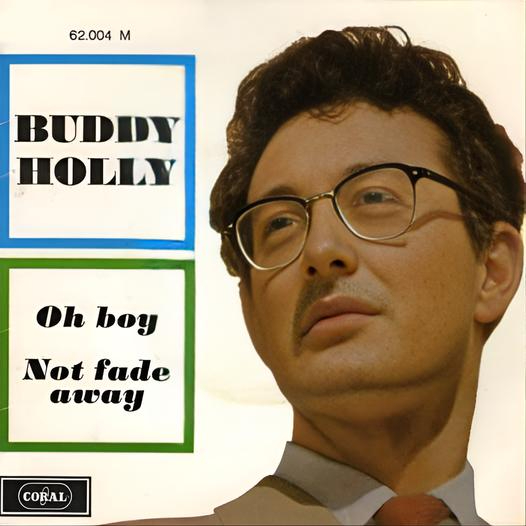

In the mythology of rock ’n’ roll, certain songs become so closely associated with an artist that history quietly blurs the truth. Buddy Holly’s explosive hit “Oh, Boy!” is one of those songs. Fierce, joyful, and overflowing with youthful energy, it feels unmistakably Holly. Yet the reality behind its creation reveals something even more fascinating: Buddy Holly didn’t write it — but he transformed it forever.
Released in 1957, “Oh, Boy!” became a defining moment in early rock music. Its driving beat, breathless vocals, and unstoppable momentum captured the spirit of a generation discovering freedom through sound. But the journey of the song — from demo tape to rock classic — tells a deeper story about collaboration, interpretation, and artistic instinct.
The Song Before Buddy Holly

“Oh, Boy!” was originally written by Sonny West, Bill Tilghman, and Norman Petty — names that don’t always get the recognition they deserve in rock history. Before Buddy Holly ever stepped into the studio, Sonny West had already recorded a demo version under the title “All My Love (Oh Boy!)”.
That early version carried the core melody and structure, but it lacked the urgency and spark that would later define the song. It was promising — but unfinished. Like many demos of the era, it was a blueprint waiting for the right voice, the right energy, and the right moment.
That moment arrived when Buddy Holly and The Crickets heard it.
The Clovis Sessions: Where the Magic Happened
During the summer of 1957, Buddy Holly and The Crickets recorded “Oh, Boy!” at Norman Petty Recording Studios in Clovis, New Mexico — a modest studio that would become legendary thanks to its role in shaping early rock ’n’ roll.
Holly didn’t approach the song as a passive performer. He reshaped it through feel, phrasing, and rhythm. The Crickets’ tight, propulsive backing gave the song a sense of forward motion that felt almost uncontrollable — as if the music itself couldn’t wait to burst out of the speakers.
This was rock ’n’ roll in its purest form: fast, emotional, and alive.
The Lyric Change That Changed Everything

One of the most revealing details about “Oh, Boy!” lies in a small but crucial lyric change.
In Sonny West’s original demo, the line went:
“All my love, all my kissing, you’re gonna see what you’ve been missing.”
Buddy Holly changed it to:
“All my love, all my kissing, you don’t know what you’ve been a-missing.”
On paper, it seems minor. In practice, it changed the song’s entire emotional tone.
Holly’s version feels more playful, more teasing, more conversational. Instead of sounding like a declaration, it sounds like a breathless confession — a young man so excited by love that he can barely get the words out. The slight grammatical twist adds charm, vulnerability, and authenticity.
That instinct — knowing how something should sound emotionally — was Buddy Holly’s true genius.
Why “Oh, Boy!” Exploded
When released, “Oh, Boy!” didn’t just perform well — it ignited. It became a staple on jukeboxes, radio stations, and dance floors across America and beyond.
Several elements made it unforgettable:
-
Relentless rhythm: The pounding beat feels like a racing heart.
-
Urgent vocals: Holly sounds ecstatic, almost overwhelmed by emotion.
-
Perfect length: Short, sharp, and impossible to forget.
-
Youthful joy: The song doesn’t reflect on love — it lives inside it.
This wasn’t polished pop. It was raw excitement — the sound of youth discovering its own voice.
Buddy Holly’s Role as an Interpreter
“Oh, Boy!” proves something essential about Buddy Holly’s legacy: great artists don’t just write great songs — they recognize them.
Holly had a rare ability to hear potential and then elevate it. He understood how to adjust lyrics, pacing, and delivery to make a song feel honest rather than rehearsed. In doing so, he didn’t overshadow the original writers — he honored them by bringing their creation fully to life.
That skill would go on to influence generations of musicians, including The Beatles, who studied Holly’s recordings obsessively.
A Song That Defines an Era
More than six decades later, “Oh, Boy!” still feels alive. It doesn’t sound dated because it isn’t tied to trends — it’s tied to emotion.
The song represents a moment when rock ’n’ roll was discovering itself:
-
when youth began speaking in its own sound,
-
when excitement mattered more than perfection,
-
and when music felt like freedom you could dance to.
Buddy Holly didn’t write “Oh, Boy!”
But he gave it its heartbeat.
And that is why history remembers the song as his.
Released in 1958, Buddy Holly’s “Heartbeat” stands as one of the most intimate and emotionally restrained songs in early rock ’n’ roll. Unlike the high-energy rebellion often associated with the genre, “Heartbeat” is quiet, vulnerable, and deeply human — a song that doesn’t shout its emotions, but lets them breathe.
Rather than telling a specific love story, “Heartbeat” captures a universal emotional state: the fragile mix of love, longing, and uncertainty that comes with caring deeply for someone. It is a song about what happens inside the heart — not the drama around it.
A Love Song Without a Plot
What makes “Heartbeat” so powerful is what it doesn’t do. There’s no clear narrative, no named lover, no dramatic turning point. Instead, the song reflects Buddy Holly’s inner world during a period of intense transition in his life.
By 1958, Holly was a rising star living almost constantly on the road. He had recently married María Elena Holly, yet spent long stretches away from her, traveling, performing, and navigating the pressures of sudden fame. That emotional distance — loving deeply while being physically apart — lives quietly within “Heartbeat.”
The song doesn’t explain that separation.
You can feel it.
Music That Mirrors Emotion
Musically, “Heartbeat” is deceptively simple — and that’s exactly why it works.
-
The steady rhythm mirrors the pulse of a heart at rest, calm but alert.
-
The subtle drum pattern feels restrained, never overpowering the melody.
-
Holly’s soft, almost whispering vocals sound intimate, as if he’s speaking directly to someone he misses.
Every element is intentional. Nothing rushes. Nothing demands attention. The song moves at the pace of emotion — careful, hesitant, sincere.
It feels like listening to someone sit alone at night, quietly thinking about the person they love.
Vulnerability in an Era of Confidence
In the late 1950s, rock ’n’ roll was often loud, confident, and rebellious. Singers projected swagger and certainty. “Heartbeat” did the opposite.
Buddy Holly allowed uncertainty into the spotlight.
The lyrics reveal a man aware of his own emotional exposure — someone who understands that love makes you vulnerable, that caring deeply means risking fear and doubt. That honesty was rare at the time, and it helped redefine what rock music could express.
This wasn’t teenage bravado.
This was emotional truth.
Why “Heartbeat” Still Resonates
Decades later, “Heartbeat” continues to resonate because its emotion is timeless. Anyone who has ever:
-
loved someone from afar
-
waited for reassurance
-
felt their heart race with both hope and worry
can recognize themselves in this song.
It doesn’t belong to a specific era.
It belongs to a feeling.
Buddy Holly’s Quiet Genius
With “Heartbeat,” Buddy Holly proved that rock ’n’ roll didn’t need volume or spectacle to be powerful. Sometimes, the most lasting songs are the ones that speak softly and trust the listener to lean in.
This song is not about grand romance.
It’s about the small, private moments of love — the ones no one else sees.
And that is why “Heartbeat” remains one of Buddy Holly’s most tender and enduring works: a reminder that even in the loudest musical revolution, there was always room for a beating heart.