
“He Was Only 37…” — The Final Hours of Alex Pretti, the Nurse the Nation Couldn’t Ignore

“He Was Only 37…” — The Final Hours of Alex Pretti, the Nurse the Nation Couldn’t Ignore
“He was only 37… and somehow, that was the moment our world stopped.”
It wasn’t a journalist speaking. It wasn’t a politician priming a teleprompter. It was a mother trying — and failing — to finish a sentence about her son, Alex Jeffrey Pretti. A son who didn’t seek headlines, who didn’t crave attention, who simply cared for others until the very end of his life.

By the early morning of January 24, 2026, a cold winter sunshine sat over Nicollet Avenue in Minneapolis. Federal immigration agents — Border Patrol and Immigration and Customs Enforcement (ICE) — were conducting an operation known as Operation Metro Surge, the largest federal immigration enforcement sweep ever carried out in the region.
Most of the world heard Alex’s name first in a clip: a calm, focused man holding a phone, recording the scene — not rushing in with violence, but observing, documenting. Video shot by multiple witnesses captured him walking alongside ordinary residents, helping direct traffic around the commotion of federal vehicles and tear gas. It looked like a neighborhood caught in chaos, not a battlefield.
At one point, an agent pushed a woman to the ground. Without hesitation, Alex moved in front of her, placing himself between her and the uniformed officer — not as an aggressor, but as a defender. It was in that moment that everything changed.
Agents sprayed him with pepper spray. They tackled him. A group of at least six agents forced him to the ground. Then, within seconds, they opened fire — at least 10 shots fired in under five seconds.
Even after he was pinned down motionless, more shots ringed out. From the cell phone footage and witness testimony, Alex never raised a weapon. Some videos show him holding only his phone — the firearm he was licensed to carry legally in Minnesota was reportedly removed from him during the struggle.
His body lay in the snow. His life flickered out within minutes — or seconds — of trying to help someone else.
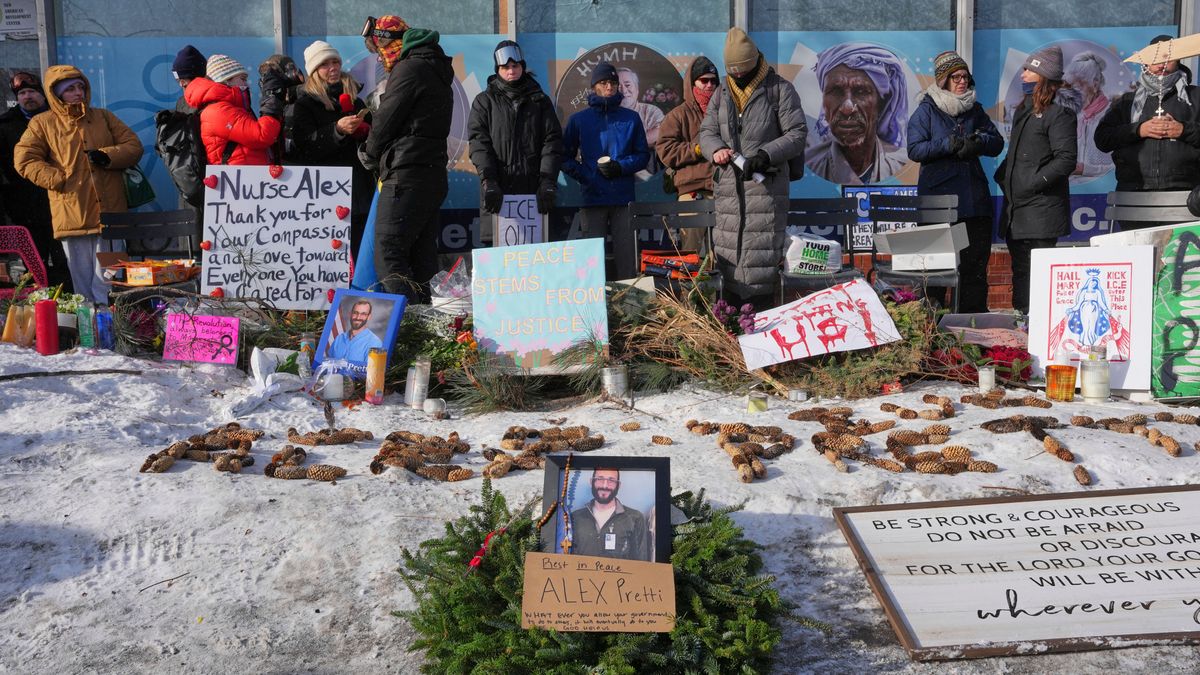
It was a killing that shook Minneapolis and then the nation: a 37‑year‑old U.S. citizen and ICU nurse killed by federal agents on an ordinary city street. He was not a criminal. He had no record of violence. Neighbors described him as warmhearted, an avid cyclist and outdoorsman, a trusted caregiver at the Minneapolis VA Medical Center.
For his family, the weeks since have been inescapable heartbreak. Initial attempts to get information from law enforcement were met with silence. They first learned of his death not from officials, but from a reporter’s call. The pain of watching bystander video — footage no parent should ever watch of their child’s final moments — was compounded by statements from federal authorities labeling Alex as a threat or even a “domestic terrorist.”
His parents’ written response was blunt, raw, and filled with both sorrow and righteous anger:
“The sickening lies told about our son by the administration are reprehensible and disgusting,” they said, insisting the footage clearly showed him unarmed and trying to protect someone else.
Why the World Took Notice
The implications of Alex’s death extended far beyond Minneapolis. Under the ongoing immigration enforcement policies of the federal government, he was the second U.S. citizen killed by federal agents in less than three weeks — following the January 7 shooting of Renée Good. The tragedies drew thousands into the streets, amplified protests across the country, and forced local and national leaders into a tense public debate over federal authority, civil rights, and accountability.
At vigils and protests, strangers shared heartbreak and outrage: candlelight gatherings where “Long live Alex Pretti” signs stood amid candles frozen by frost; marches from Minneapolis to San Francisco, New York City to Boston, echoing a demand that justice not become yet another casualty.
Danica Patrick Speaks — A Voice From Another World
Then came an unexpected voice — one from outside politics, outside traditional activism, yet resonating with millions: Danica Patrick, the legendary racecar driver whose fearless nature on the NASCAR circuit made her a household name long before she retired.
Danica isn’t known for occupying political stages. She’s known for courage — pursuit of speed, precision, and integrity in one of the world’s most dangerous sports. But when she saw Alex’s story, she didn’t stay quiet. In a video message shared across social platforms, her voice carried an urgency that startled many:
“I know what courage looks like — it’s every driver who pushes past fear to do their job. But real courage isn’t only on a track. It’s in someone who steps between danger and a stranger to protect them. Alex Pretti reminds us that bravery comes in many forms. He didn’t seek applause. He didn’t chase fame. He cared for the wounded, served veterans with compassion, and stood up for people who couldn’t stand for themselves.”
:max_bytes(150000):strip_icc():focal(749x0:751x2)/Alex-Pretti-012526-2-750d486a97134c3fa48e5882709769d8.jpg)
Her words struck a chord. They turned a local tragedy into a broader conversation about values, duty, and humanity — qualities even the fastest cars and fiercest races can’t measure.
The Aftermath: Protests, Politics, and a Nation Divided
In Minneapolis and beyond, the response to Alex’s death has not been quiet. Protesters rallied outside federal buildings, demanding ICE leave Minnesota immediately; union leaders condemned the violence; local officials accused federal agents of blocking investigations and destroying evidence; and legal battles began over access to body‑cam footage and independent review of the shooting.
Minnesota’s governor said federal actions “represented an inflection point in America,” adding that sweeping away evidence and denying local law enforcement access only deepened mistrust.
Nationwide, lawmakers from both parties — including Republican and Democratic senators — have voiced outrage, calling for transparency, accountability, and a thorough investigation into how an ICU nurse ended up dead after trying to help a community.
The Person Behind the Headline
Alex’s story is much more than a political flashpoint or a viral video clip. Those who knew him paint a fuller, poignant picture — a life defined not by crisis, but by compassion. Friends remember him as a quiet man with a gentle laugh, a mentor to younger nurses, a protector of veterans returning from war. Neighbors recall his kindness and willingness to help with even the smallest concerns.
In Green Bay, where he grew up, classmates speak of a boy who played sports, sang in choirs, and once stood on the shoulders of friends to see the world from a broader perspective. At the University of Minnesota, where he studied sciences, teachers saw promise, empathy, and a quiet strength that would become his defining trait.
And Yet… the Story Isn’t Over
As of now, the federal investigation remains limited by internal reviews, with local officials fighting for transparency. Legal battles over evidence preservation are underway, and the nation watches as footage, witness testimony, and official statements continue to clash.
In the streets and online, the name Alex Pretti has become more than a headline — it has become a symbol, a question, and for many, a call to action.
What happens when a man who spent his life caring for others dies in broad daylight at the hands of those entrusted to protect us?
That question won’t fade easily. And for those who knew him, and for millions now grappling with what his death means, the world won’t stop asking it either.