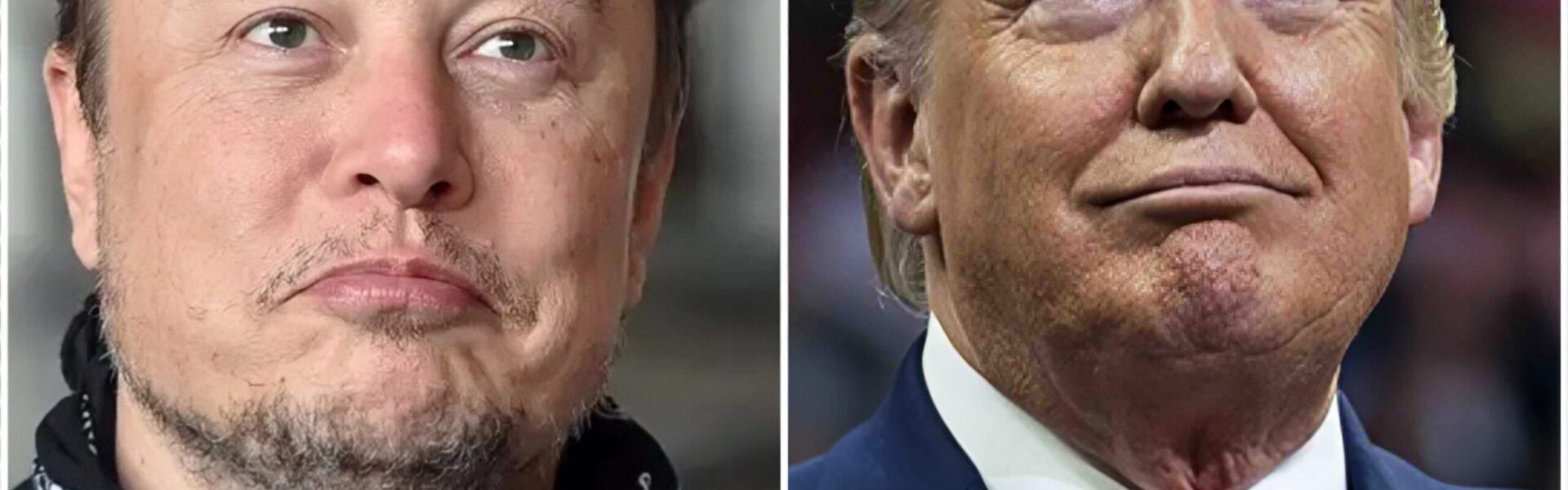

The public feud between billionaire Elon Musk and U.S. President Donald Trump has sent shockwaves through the financial world, causing Tesla’s stock to plummet and wiping tens of billions of dollars off Musk’s personal fortune. The fallout from this “breakup” between two former allies is more than just an immediate financial hit—it also carries potential long-term consequences.
During Trump’s first presidential term (2017–2021), Elon Musk was a prominent supporter of policies aimed at boosting domestic manufacturing. He was invited to join advisory councils on economic and industrial policy, acting as a bridge between the White House and Silicon Valley. Musk’s involvement helped position him as a strategic player in shaping U.S. economic priorities.

The relationship intensified when Trump was re-elected in early 2025. One of the most notable initiatives was the executive order establishing the Government Performance Office (DOGE), a federal reform plan designed to “cut waste, streamline spending, and maximize efficiency.” Musk saw DOGE as a way to reduce trillions of dollars in federal expenditure, but the initiative quickly became controversial, facing strong resistance from Congress, federal unions, and traditional political circles.
By the end of May 2025, Musk stepped down from his official role at DOGE after completing the 130-day term as a “special government employee.” This withdrawal marked a turning point, paving the way for public tension between the two figures. Musk’s increasingly critical stance on Trump’s fiscal and economic policies transformed a once-strategic alliance into a tangible financial risk. The impact on Tesla’s stock and Musk’s personal wealth was immediate and severe.
Assets and Market Capitalization Vaporize with Each Statement
Musk’s public criticism of the “One Big Beautiful Bill Act” (OBBBA) in early June 2025, combined with his hints about potentially creating a new political party, disrupted the fragile balance of his relationship with President Trump. On social media platform X, Musk argued that the tax-and-spending package would exacerbate the federal deficit and severely harm the U.S. electric vehicle industry. His political hints were seen by the White House as a direct challenge.
Just days later, Trump responded publicly and suggested reviewing government contracts awarded to Musk’s companies, including Tesla and SpaceX. Investors reacted immediately. On July 1, 2025, Tesla shares fell 5.3%, reaching their lowest level in three weeks, and Musk’s net worth dropped by $12.1 billion in a single day, making him the biggest financial loser of that session.
This was not the first time Musk-Trump tensions rattled markets. Earlier in June, after Musk labeled OBBBA as “a disgusting mistake,” Trump threatened to cancel government contracts with Musk’s companies. In a single trading session, Tesla’s stock plunged over 14%, erasing $152 billion in market capitalization and slashing Musk’s personal wealth by approximately $34 billion. These figures underscore how political conflicts between high-profile individuals can translate into immediate and measurable financial risk.

Core Profits and Subsidies at Stake
The Trump-Musk rift extends beyond market capitalization—it also jeopardizes Tesla’s core profit streams, closely tied to government policy. While Musk has repeatedly advocated for the removal of subsidies, Tesla has benefited for years from federal incentives for electric vehicles and renewable energy programs worth billions of dollars.
According to J.P. Morgan, losing these EV subsidies could cost Tesla an additional $1.2 billion, equivalent to roughly 17% of operating income in 2024. The Trump administration controls many of these programs, including the $7,500 incentive for EV buyers or lessees, which has been critical in stimulating demand for clean vehicles.
Trump has openly indicated that policy could be used as leverage against Musk. On Truth Social, he commented that without subsidies, “Elon might as well pack up and return to South Africa.” He also suggested that reducing government spending on rockets, satellites, and EVs could save the federal government “a massive sum of money.”
Another risk lies in Tesla’s emissions credit business, which generates billions annually by selling credits to automakers that fail to meet environmental standards. Without these sales, Tesla would have recorded losses in Q1 2025. Given that the Trump administration oversees relevant federal programs and environmental policies, this vital revenue stream is also at risk.
Notably, Trump has hinted that DOGE, the agency Musk once led, could be revived to scrutinize subsidies granted to Musk’s companies. “You know DOGE, right? It’s the monster that could swallow Elon whole,” Trump remarked.
Musk responded on X: “I say cut it all. Right now,” while acknowledging he could escalate tensions further but would “temporarily hold back.”

Strategic Risks: Robotaxi and Tesla Brand
The fallout also casts a shadow over Tesla’s long-term growth strategy, particularly its autonomous taxi (robotaxi) ambitions—a potential revenue and valuation driver. Tesla is currently testing robotaxis in Austin, Texas, but nationwide deployment depends heavily on federal and state regulatory approval. With tensions rising between Musk and the Trump administration, policy risk for this initiative has become more pronounced.
Gene Munster, a specialist at Deepwater Asset Management, observed that Tesla’s valuation is largely based on expectations for self-driving technology. “There isn’t an immediate impact, but the risk is real,” he noted, referring to the potential long-term consequences of political friction.
Brand risk is also significant. Musk acknowledged that boycotts linked to his political views have affected Tesla sales. While he considers these impacts temporary, consumer pressure has not fully eased even after the release of the new Model Y.
End-of-Year Developments
By the end of 2025, Elon Musk’s financial and political landscape saw new developments. In December, the Delaware Supreme Court reinstated Musk’s 2018 compensation package, initially valued at $56 billion and now estimated at over $139 billion, substantially bolstering his personal wealth and ability to lead Tesla.
Politically, Trump and Musk appeared together at an event in September 2025, which media outlets described as a partial “reunion.” However, analysts suggest this was largely a tactical truce rather than a full restoration of their early-term alliance.
The Musk-Trump saga highlights how personal and political conflicts at the highest levels can quickly become financial realities, affecting companies, markets, and strategic plans. For Elon Musk, the stakes remain enormous—not just for Tesla and SpaceX, but for his position as a central figure in global business and innovation. Whether this “breakup” will permanently alter his trajectory—or whether he can navigate the choppy waters of politics and finance—remains a story closely watched by investors and the public alike.
https://www.youtube.com/watch/TYaKZUxwOXQ