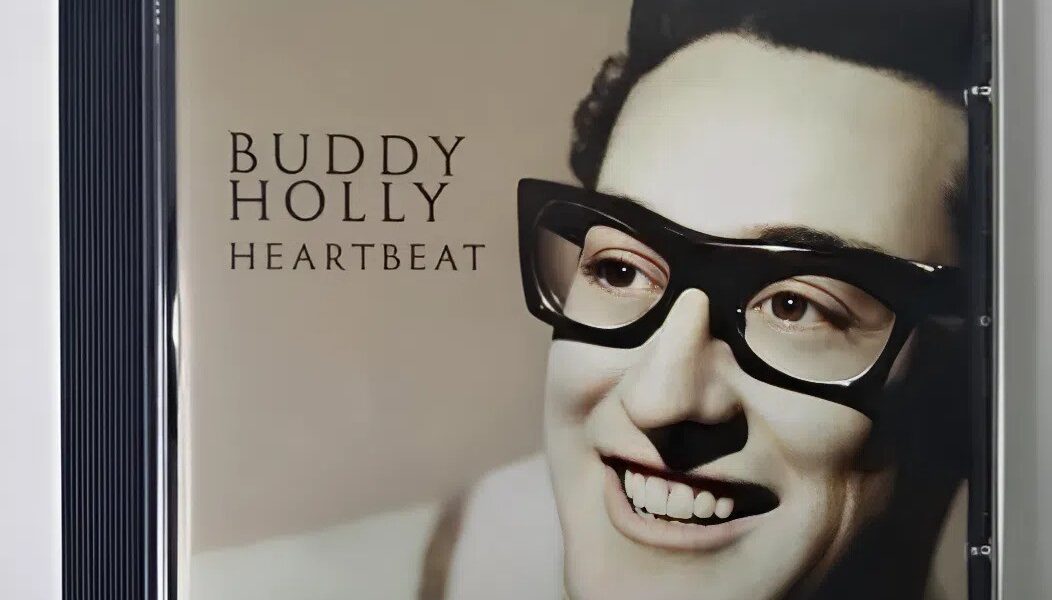

Released in 1958, Buddy Holly’s “Heartbeat” stands as one of the most intimate and emotionally restrained songs in early rock ’n’ roll. Unlike the high-energy rebellion often associated with the genre, “Heartbeat” is quiet, vulnerable, and deeply human — a song that doesn’t shout its emotions, but lets them breathe.
Rather than telling a specific love story, “Heartbeat” captures a universal emotional state: the fragile mix of love, longing, and uncertainty that comes with caring deeply for someone. It is a song about what happens inside the heart — not the drama around it.
A Love Song Without a Plot
What makes “Heartbeat” so powerful is what it doesn’t do. There’s no clear narrative, no named lover, no dramatic turning point. Instead, the song reflects Buddy Holly’s inner world during a period of intense transition in his life.
By 1958, Holly was a rising star living almost constantly on the road. He had recently married María Elena Holly, yet spent long stretches away from her, traveling, performing, and navigating the pressures of sudden fame. That emotional distance — loving deeply while being physically apart — lives quietly within “Heartbeat.”
The song doesn’t explain that separation.
You can feel it.
Music That Mirrors Emotion
Musically, “Heartbeat” is deceptively simple — and that’s exactly why it works.
-
The steady rhythm mirrors the pulse of a heart at rest, calm but alert.
-
The subtle drum pattern feels restrained, never overpowering the melody.
-
Holly’s soft, almost whispering vocals sound intimate, as if he’s speaking directly to someone he misses.
Every element is intentional. Nothing rushes. Nothing demands attention. The song moves at the pace of emotion — careful, hesitant, sincere.
It feels like listening to someone sit alone at night, quietly thinking about the person they love.

Vulnerability in an Era of Confidence
In the late 1950s, rock ’n’ roll was often loud, confident, and rebellious. Singers projected swagger and certainty. “Heartbeat” did the opposite.
Buddy Holly allowed uncertainty into the spotlight.
The lyrics reveal a man aware of his own emotional exposure — someone who understands that love makes you vulnerable, that caring deeply means risking fear and doubt. That honesty was rare at the time, and it helped redefine what rock music could express.
This wasn’t teenage bravado.
This was emotional truth.
Why “Heartbeat” Still Resonates
Decades later, “Heartbeat” continues to resonate because its emotion is timeless. Anyone who has ever:
-
loved someone from afar
-
waited for reassurance
-
felt their heart race with both hope and worry
can recognize themselves in this song.
It doesn’t belong to a specific era.
It belongs to a feeling.
Buddy Holly’s Quiet Genius
With “Heartbeat,” Buddy Holly proved that rock ’n’ roll didn’t need volume or spectacle to be powerful. Sometimes, the most lasting songs are the ones that speak softly and trust the listener to lean in.
This song is not about grand romance.
It’s about the small, private moments of love — the ones no one else sees.
And that is why “Heartbeat” remains one of Buddy Holly’s most tender and enduring works: a reminder that even in the loudest musical revolution, there was always room for a beating heart.