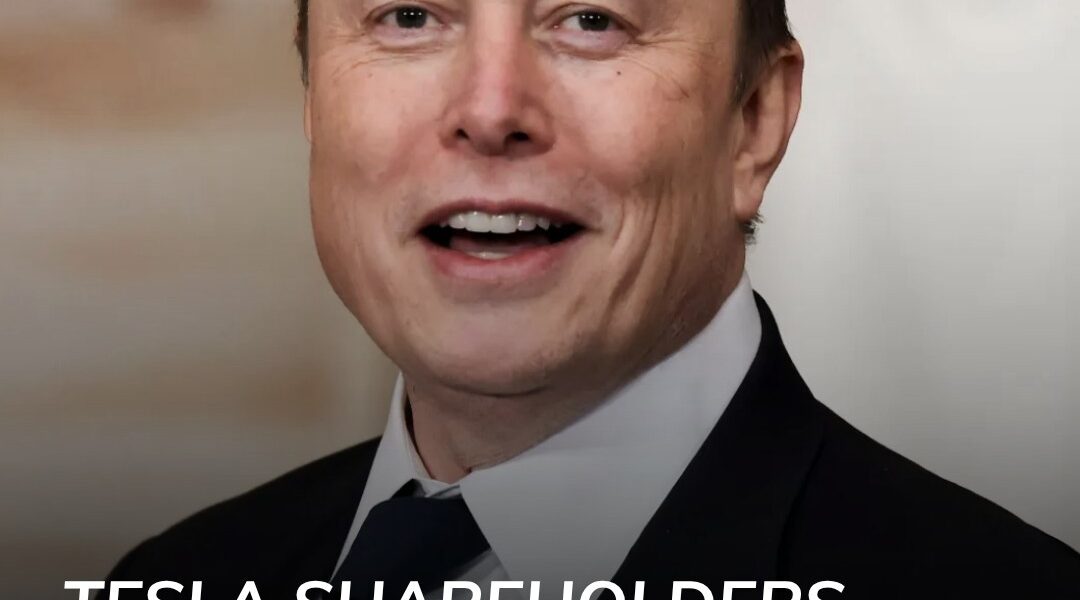
Tesla Shareholders Approve Record-Breaking $1 Trillion Pay Package for Elon Musk — The Largest Executive Compensation Deal in History

In a decision that has instantly reshaped conversations about executive power, corporate governance, and the future of capitalism, Tesla shareholders have approved what is being described as the largest executive compensation package in human history—a staggering $1 trillion performance-based pay deal for CEO Elon Musk. The vote, which passed after weeks of intense debate and global scrutiny, marks a watershed moment not only for Tesla, but for how the world understands leadership at the frontier of technology and industry.
The approval did not come quietly. It arrived amid protests from governance watchdogs, skepticism from traditional investors, and awe from supporters who view Musk as a once-in-a-century architect of progress. When the final vote tally was announced, markets reacted instantly, analysts scrambled to rewrite models, and social media erupted with disbelief. One phrase trended worldwide within minutes: “Is this the future of leadership—or the breaking point?”
A Pay Package Unlike Anything Before
Unlike conventional executive compensation built on salary, bonuses, and stock grants, Musk’s trillion-dollar package is structured almost entirely around extreme performance milestones. According to details shared with shareholders, Musk receives no guaranteed cash. Every dollar is tied to Tesla achieving unprecedented benchmarks in market capitalization, revenue growth, global manufacturing scale, AI autonomy, and energy infrastructure deployment.
Supporters emphasize that this is not a “gift,” but a bet—one that only pays off if Tesla transforms not just the auto industry, but energy, robotics, and artificial intelligence at a planetary scale.
“If Tesla fails to execute,” one board member reportedly stated, “this package is worth zero.”
That framing has become central to the defense of the deal.
Why Shareholders Said Yes

To many long-term Tesla investors, the vote was less about compensation and more about retention and alignment. Musk is not only Tesla’s CEO, but also the public face of its ambition—electric vehicles, autonomous driving, humanoid robots, grid-scale batteries, and AI systems all converge under his leadership.
Shareholders who voted in favor argue that no traditional CEO could plausibly deliver on Tesla’s roadmap. Losing Musk, they say, would represent an existential risk.
“People forget,” said one major institutional investor, “Tesla isn’t valued like a car company. It’s valued like a civilization-scale technology platform. This pay package reflects that reality.”
Others pointed out that Musk already holds a massive stake in Tesla and has repeatedly declined cash compensation in the past. The new package, in their view, simply formalizes what has already been true: Musk’s wealth rises or falls with Tesla’s success.
The Backlash Is Immediate—and Fierce
Critics, however, see the decision as a line crossed.
Corporate governance experts warn that a trillion-dollar pay package—no matter how performance-based—sets a dangerous precedent. They argue it concentrates too much power in a single individual and risks normalizing extreme inequality within corporate structures.
“This isn’t about whether Elon Musk is talented,” one governance analyst said. “It’s about whether any human being should wield this level of economic influence through one company.”
Labor advocates also raised concerns about optics. As Tesla continues to automate factories and reduce labor costs, the contrast between worker wages and executive compensation has become a flashpoint.
On social media, reactions ranged from admiration to outrage. Some called Musk “the ultimate value creator.” Others called the vote “proof that shareholder capitalism has lost its moral compass.”
Musk’s Response: Characteristically Unfiltered
Elon Musk himself responded with a brief, characteristically blunt statement on X:
“This only works if Tesla delivers extraordinary results. If we don’t, I get nothing. That’s the deal.”
He later added:
“The goal isn’t money. The goal is accelerating the future.”
To supporters, the remarks reinforced Musk’s image as a mission-driven leader. To critics, they sounded dismissive of legitimate concerns.
What This Means for Tesla
From a strategic standpoint, the approval sends a powerful signal: shareholders are doubling down on Musk’s long-term vision, even at the cost of controversy. Tesla’s roadmap now stretches far beyond vehicles—toward fully autonomous transportation networks, AI-driven manufacturing, and energy systems that could redefine national grids.
Some analysts believe the pay package will embolden Musk to take even bolder risks, knowing that shareholders have effectively given him a mandate to pursue moonshot projects without short-term restraint.
Others warn that the pressure to meet trillion-dollar milestones could incentivize aggressive decision-making, potentially increasing volatility.
A Turning Point for Executive Compensation
Beyond Tesla, the implications are seismic. Boards across Silicon Valley and beyond are watching closely. If Musk succeeds, performance-based mega-compensation could become the new model for visionary CEOs. If he fails, this deal may be remembered as a cautionary tale.
“This vote will be taught in business schools for decades,” one professor noted. “Not as a curiosity—but as a turning point.”
The Bigger Question
At its core, the controversy raises a deeper question about modern capitalism: How do we measure value? Is it by jobs created, technologies delivered, emissions reduced—or by market capitalization alone?

For Tesla shareholders who approved the deal, the answer is clear. They are betting that Elon Musk can continue to bend industries, timelines, and expectations—and that the rewards, however extreme, will be justified by results that reshape the world.
Whether history agrees remains to be seen.
For now, one thing is undeniable: with this vote, Tesla shareholders didn’t just approve a pay package. They endorsed a vision of leadership where the stakes—and the numbers—are larger than anything that has come before.