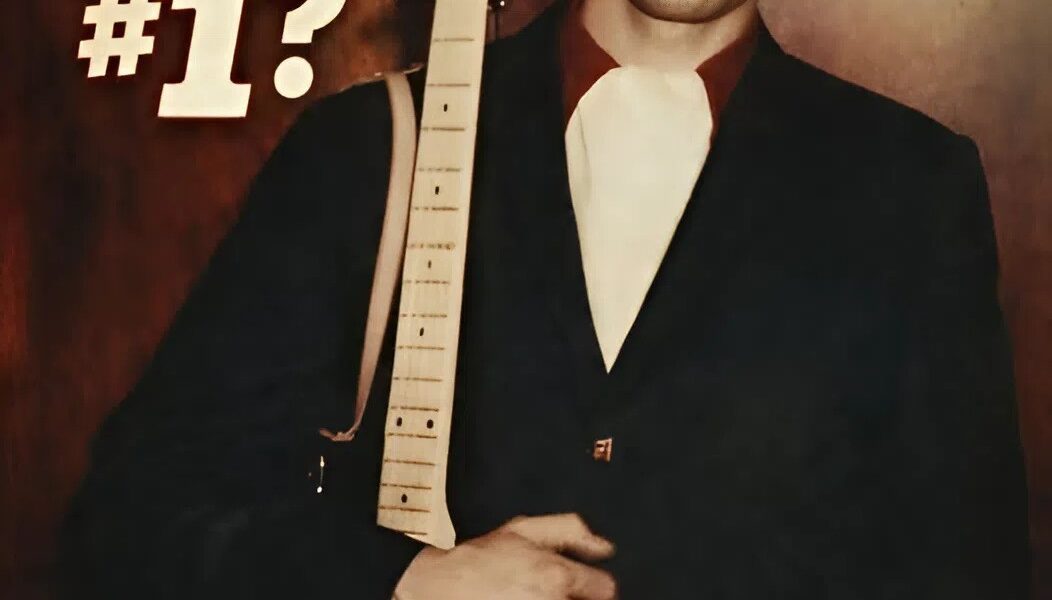
That may be hard to believe, considering how many of his songs went on to become timeless classics. But in the United States, only one single reached the top of the charts: “That’ll Be the Day” in 1957.

Only One No. 1 Hit — And Yet, Music Was Never the Same Again
Buddy Holly had just one No. 1 hit.
That fact still surprises people today. In an era when his name is spoken with the same reverence as Elvis Presley, Chuck Berry, and Little Richard, it feels almost impossible. His songs are everywhere. His influence is everywhere. His shadow stretches across decades of rock, pop, and popular culture.
And yet, in the United States, only one Buddy Holly song ever reached the top of the charts: “That’ll Be the Day” in 1957.
One song. One moment at No. 1.
But measuring Buddy Holly by chart positions misses the entire point of who he was — and what he changed forever.
A Hit That Opened the Door
When “That’ll Be the Day” hit No. 1, it didn’t sound like most popular records of the time. It was lean, urgent, and youthful. The rhythm felt modern. The vocal delivery felt personal, almost conversational. It wasn’t polished in the way older pop records were — and that was precisely its power.
Buddy Holly didn’t sing at the audience. He sang to them.
The song crossed boundaries effortlessly. It topped charts in the United States, then climbed to No. 1 in the United Kingdom as well, proving that rock and roll was no longer a local phenomenon. It was becoming a global language.
But the true aftershock of “That’ll Be the Day” didn’t come from its chart success. It came from who was listening.
Four Teenagers in Liverpool
Not long after its release, “That’ll Be the Day” was recorded again — not by an established act, but by a young band in their very first recording session. They called themselves The Quarrymen.
The lineup was raw. The equipment was basic. The ambition, however, was limitless.
The group would later be known to the world as The Beatles.
That choice — to record a Buddy Holly song as their first-ever studio effort — was not an accident. For young musicians across Britain, Buddy Holly represented something revolutionary: proof that a band could write its own songs, play its own instruments, and sound authentic without relying on elaborate production or industry machinery.
John Lennon would later say that Buddy Holly’s glasses, his songwriting, and his quiet confidence made him relatable in a way no one else had.
Holly didn’t look like a star.
That made people believe they could become one.
More Than the Charts Could Measure
Buddy Holly never needed a long list of No. 1 hits to matter. His influence lived elsewhere — in structure, attitude, and possibility.
He helped define the modern rock band format: singer-guitarist at the front, tight rhythm section behind him, original material as the foundation. That template became the blueprint for generations.
Songs like “Peggy Sue,” “Everyday,” “Rave On,” and “Not Fade Away” didn’t always dominate charts, but they rewired how music was written and performed. Short songs. Clear hooks. Emotional directness. Youthful honesty.
These weren’t just hits.
They were instructions.
A Career Cut Short — A Legacy That Wasn’t
Buddy Holly’s life ended tragically in 1959, at just 22 years old. His career barely lasted three years. There was no long decline, no reinvention phase, no comeback tour.
And yet, his influence only grew after his death.
The Rolling Stones, Bob Dylan, The Byrds, Elton John, and countless others cited him as foundational. Paul McCartney would later buy the rights to Holly’s song catalog — not as a business move, but as an act of admiration.
Holly showed that musicians didn’t need to be larger than life.
They just needed to be real.
One No. 1 — Infinite Impact
So yes, Buddy Holly had only one No. 1 hit.
But that single chart statistic cannot account for the bands he inspired, the songwriting revolution he accelerated, or the cultural shift he helped ignite. His influence lives not in rankings, but in echoes — in every guitar-driven band that followed, in every artist who believed they could write their own truth and be heard.
Music history isn’t shaped only by numbers.
It’s shaped by moments.
And with one song at No. 1, Buddy Holly helped change everything.