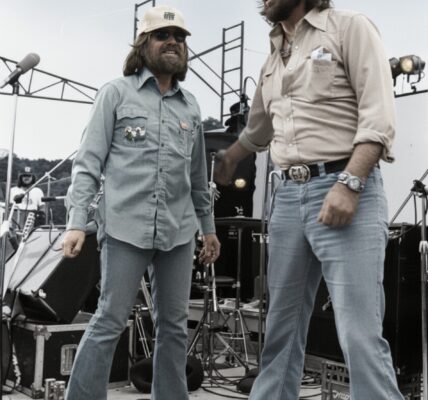

Waylon Jennings – The Long Road Behind “Just to Satisfy You”
Some songs are written in minutes but take decades to find their moment. “Just to Satisfy You” is one of them — a country classic that traveled a winding 22-year path before finally reaching the No.1 spot, cementing itself in the legacies of both Waylon Jennings and Willie Nelson.

Origins in Friendship and Doubt
The song was born in 1960 in Phoenix, Arizona, during one of Waylon Jennings’ occasional songwriting reunions with his longtime friend and collaborator, Don Bowman. Before writing music together, the two had worked as radio DJs at KLLL in Lubbock, Texas, building a friendship grounded in shared late-night shifts, humor, and a love for country storytelling.
Despite their chemistry, the first draft of “Just to Satisfy You” nearly didn’t survive. Waylon, known for being notoriously hard to please with his own work, disliked the song at first. Both men even considered discarding it entirely. It was only after adding a final verse and a bridge that the song finally felt complete — saved by persistence and a last-minute creative spark.
Early Recordings and Unusual Arrangements
Jennings recorded the track multiple times throughout his career, each version reflecting a different era of his evolving sound. The first official studio recording was for A&M Records, produced by Herb Alpert. In a decision that would surprise traditional country fans today, the arrangement featured a harpsichord — an instrument rarely associated with the genre. Though musically bold, the version didn’t ignite the charts.
Waylon also recorded the song for his crucial RCA audition session, produced by country powerhouse Chet Atkins. That recording helped earn Jennings a contract with RCA — a turning point that launched him into a new chapter as one of the label’s most promising artists.

Bobby Bare’s Version and the Missed Opportunity
In 1965, RCA artist Bobby Bare released his own rendition. The performance was smooth, emotional, and widely praised for its vocal sincerity. Yet, despite its quality, the song stalled at No.31 on the Billboard Country Chart. Bare, talented but often unlucky with chart peaks, had experienced similar near-misses before. Even his famous hit “Detroit City” reached only No.6 in 1963, and his sole chart-topper came much later in 1974 with the humorous track “Marie Laveau.”
Waylon himself re-cut the song again in 1969, using it as the title track for his tenth RCA album. The song had now appeared in three distinct phases of his career — experimental, hopeful, and established — but it still hadn’t reached its full potential.
The 1982 Duet That Changed Everything
The breakthrough finally arrived in 1982 when Jennings recorded “Just to Satisfy You” as a duet with Willie Nelson for the album “Black on Black.” Interestingly, the idea came more from Nelson than Jennings. Don Bowman had even been secretly encouraging Willie to record the song during the duet sessions.
The timing couldn’t have been better. Just weeks earlier, Nelson had released “Always on My Mind,” which also soared to No.1. With the duet release of “Just to Satisfy You,” Willie dominated the Billboard Country Chart for four consecutive weeks — marking only the ninth time in history, and the first since 1964, that the same artist held No.1 with back-to-back singles. In 1964, Buck Owens had achieved the same feat with “My Heart Skips a Beat” followed by “Together Again.”
For Waylon, the success validated decades of belief in a song that almost ended up in a trash can.

Don Bowman – More Than a Songwriter
While Waylon and Willie carried the track to chart glory, Don Bowman carved out his own path at RCA as a country comedian and radio personality. Between 1964 and 1970, he released comedy LPs, four of which charted on Billboard’s Country Album list. His 1966 album “Funny Way to Make an Album” even earned a Billboard award for Favorite Country Comedy Recording of the Year, followed by a CMA Comedian of the Year title in 1967 — a category discontinued soon after.
Bowman also became the first-ever host of ABC’s American Country Countdown, leading the program from 1973 until 1978 before Bob Kingsley took over. Beyond comedy and broadcasting, Bowman continued writing hits, including “Wildwood Weed,” which crossed into pop success when recorded by Jim Stafford, peaking at No.7 on the Billboard Hot 100 in 1974.
A Song That Defines the Outlaw Era
Today, “Just to Satisfy You” is remembered not for the versions that missed the charts, but for the journey that shaped it. It reflects the stubborn perfectionism of Waylon Jennings, the instinctive hit-making vision of Willie Nelson, and the quiet influence of Don Bowman — a trio that indeed sounds like a law firm, but built something far more lasting: a timeless piece of country music history.
Legacy in Lyrics and Emotion
The song’s lyrics warn of heartbreak, manipulation, and emotional consequences, themes that mirror the turmoil often sung about in the Outlaw Country era — a movement Waylon helped pioneer. Lines like “How many hearts must break? How many will it take to satisfy you?” echo the song’s original message: emotional pain leaves a cost, even when the song itself was crafted to satisfy a perfectionist.