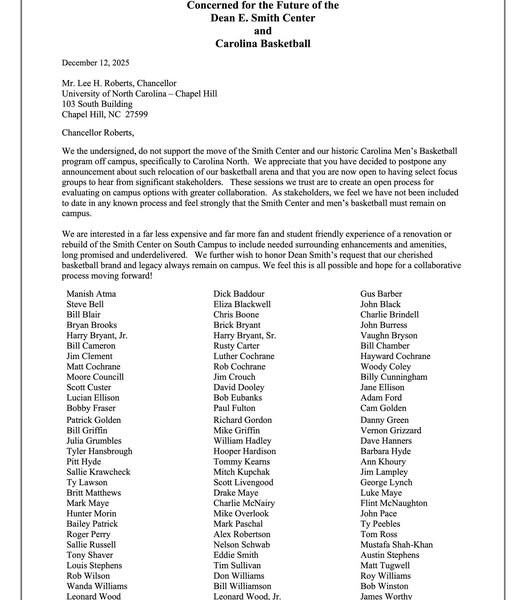

This letter truly mattered.
In an era where fans often feel powerless against administrative decisions and long-term institutional planning, an open letter to Chancellor Lee Roberts has proven that collective voices still carry weight. What began as a statement of concern has already made a tangible impact — slowing momentum around the proposed relocation of the Dean E. Smith Center and reopening conversations that many believed were already closed.
The message was clear, respectful, and grounded in history. And it was heard.
But supporters of the Smith Center are under no illusions. No final decision has been made. No guarantees have been offered. And the future of one of college basketball’s most sacred arenas remains uncertain.
That is precisely why the letter is being shared again — not as repetition, but as reinforcement.

Why the Smith Center Matters — And Why Location Is Everything
To outsiders, the debate may sound like a simple facilities question: new arena versus old, modernization versus nostalgia. But for those who understand North Carolina basketball, the issue cuts far deeper.
The Dean E. Smith Center is not just a building. It is a geographic and emotional anchor of Tar Heel identity.
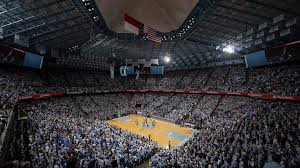
Situated on South Campus, the arena is woven into the daily life of the university. Students walk past it on their way to class. Alumni return to it as a pilgrimage. The surrounding space is not incidental — it is integral.
Moving the Smith Center is not simply relocating a venue. It risks severing the invisible thread that binds:
-
Campus life
-
Basketball culture
-
Generational memory
-
Community connection
The open letter articulated this reality with clarity: progress does not require displacement, and modernization does not have to come at the expense of meaning.
The Impact So Far: Momentum Paused, Dialogue Reopened
One of the most significant outcomes of the letter has been its immediate effect on the decision-making process.
According to those close to the situation, momentum toward relocation has slowed. Conversations that once seemed procedural have become reflective. Stakeholders — including alumni, former players, donors, and community members — are being brought back into discussions that many felt excluded from.
This pause matters.
It demonstrates that leadership is listening, and that the university recognizes the emotional and cultural dimensions of the issue — not just the financial or architectural ones.
Still, a pause is not a resolution.
UNC has made no final commitment to keeping the Smith Center on South Campus. The long-term vision remains under review, and competing pressures — revenue, facilities standards, and future growth — are still very real.
That is why supporters understand this moment not as a victory, but as an opening.
Expanding the Movement: Why This Fight Is Far From Over
Re-sharing the letter is about scale.
It is about ensuring that the decision reflects the will of the broader Tar Heel community — not just a limited set of voices or timelines. Every signature, every share, and every public statement reinforces a simple truth: the Smith Center belongs not only to the university, but to the people who gave it meaning.
The petition supporting the campaign is not an act of defiance. It is an act of stewardship.
By signing and sharing, supporters are saying:
-
Honor legacy alongside innovation
-
Preserve connection while planning for the future
-
Involve the community in decisions that define identity
This is not resistance to change. It is insistence on thoughtful change.
History shows that the strongest programs are those that evolve without forgetting who they are. UNC basketball has always prided itself on values — continuity, respect, and shared ownership between institution and community.
This moment will test whether those values still guide the path forward.
What Comes Next: A Defining Chapter for Carolina Athletics
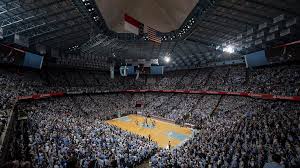
The future of the Dean E. Smith Center remains undecided. But one thing is now undeniable: the conversation has shifted.
What was once framed as an administrative project has become a community-wide reckoning with heritage, identity, and responsibility. The letter reminded leadership that progress cannot be measured solely in square footage or revenue projections.
It must also be measured in trust.
As discussions continue, the Tar Heel community has an opportunity — and an obligation — to stay engaged. Silence now would undo the progress already made.
This is not about freezing time. It is about choosing a future that respects the past.
The fight is far from over.
And for those who care about Carolina basketball, it is a fight worth continuing.