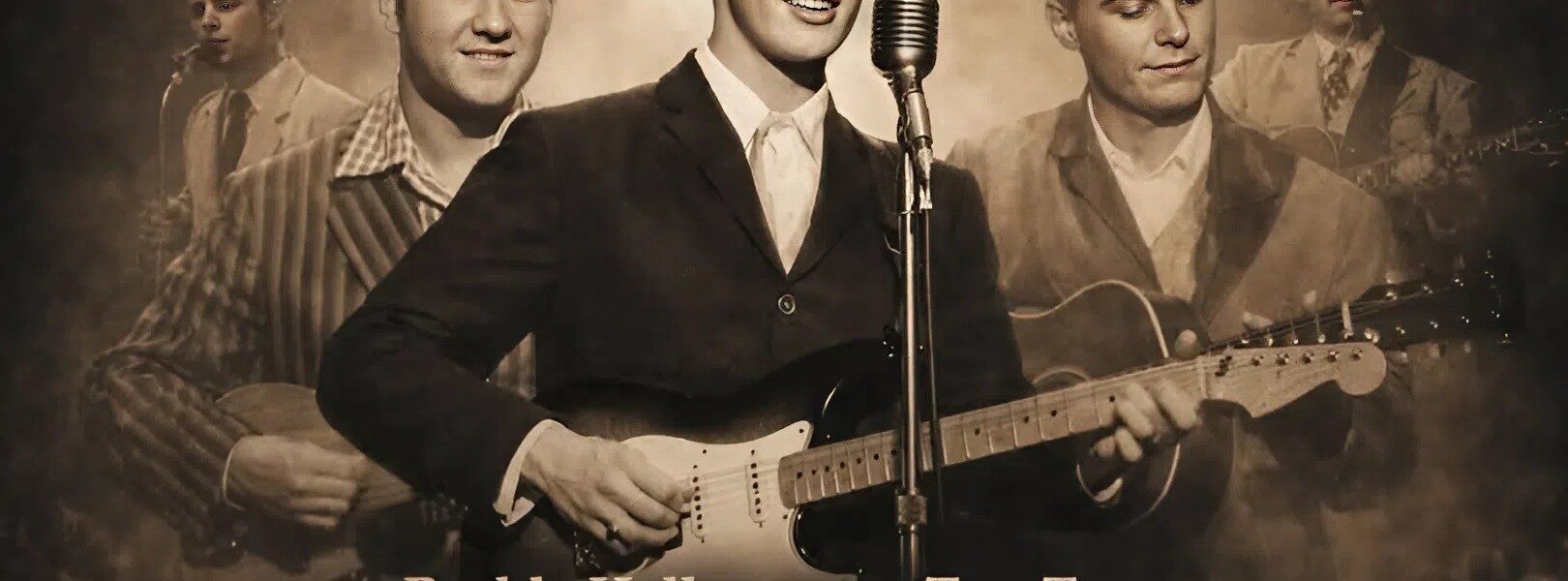
A young trio known as Buddy Holly and the Two Tones, featuring Sonny Curtis and Don Guess, set out on a two-week tour across the southern United States

January 9, 1956: When a Young Trio Stepped Onto the Road of History
On January 9, 1956, few people in the American South realized they were witnessing the earliest footsteps of a musical revolution. There were no screaming crowds, no chart-topping singles, no headlines announcing a future legend. Just a young trio, a modest tour schedule, and miles of highway stretching across the southern United States.
They called themselves Buddy Holly and the Two Tones.
The group featured a skinny, soft-spoken 19-year-old from Lubbock, Texas — Buddy Holly — alongside guitarist Sonny Curtis and bassist Don Guess. That winter, they joined a two-week regional tour as a supporting act for established country stars George Jones and Hank Thompson.
At the time, this was not rock history.
It was simply work.

Sharing the Road With Country Royalty
Touring with George Jones and Hank Thompson placed Buddy Holly and the Two Tones squarely within the traditional country music circuit. These were honky-tonk halls, dance venues, and small-town auditoriums — places where audiences expected fiddles, steel guitars, heartbreak songs, and familiar sounds.
Rock and roll, still in its infancy, was not yet fully accepted — especially in the South. Elvis Presley was just beginning to shake cultural foundations. Chuck Berry had not yet dominated the airwaves. For Buddy Holly, this tour was less about rebellion and more about learning.
Night after night, the trio watched seasoned performers command crowds, pace a setlist, and survive the grind of the road. They learned how to adapt to different rooms, different audiences, and unpredictable sound systems. They learned discipline, timing, and resilience.
This was the classroom.
The road was the teacher.
A Band Still Becoming Itself
In early 1956, Buddy Holly was still searching for his musical identity. The Two Tones leaned heavily toward country and western influences, reflecting the realities of the venues they played. Their sound had not yet hardened into the sharp, guitar-driven rock style that would later define Holly’s legacy.
But something was forming.
Holly was already experimenting with vocal phrasing that felt more conversational than theatrical. His guitar playing, though restrained, hinted at rhythmic instincts that would soon become revolutionary. More importantly, he was absorbing everything — watching how crowds responded, how energy shifted, how authenticity mattered more than perfection.
This tour gave him something no studio could:
context.

It taught him where music came from — and where it needed to go.
The Importance of Being the Opening Act
Being a supporting act meant short sets, limited attention, and little room for error. But it also meant freedom. Buddy Holly and the Two Tones could try things. Adjust arrangements. Feel out the audience without the pressure of headlining expectations.
Sometimes they were warmly received.
Sometimes politely ignored.
Sometimes met with confusion.
All of it mattered.
Holly learned quickly that audiences didn’t just want songs — they wanted connection. Even in rooms built for country music, there were listeners hungry for something new, something youthful, something that spoke differently.
Those moments planted seeds.
From Two Tones to the Crickets
Within a year, Buddy Holly’s career would accelerate at a breathtaking pace. The Two Tones would dissolve. New collaborators would emerge. The Crickets would form. Hits like “That’ll Be the Day” and “Peggy Sue” would redefine what a rock band could be.
But none of that happened in isolation.
The discipline of touring.
The humility of opening sets.
The influence of country storytelling.
The grind of the southern road.
All of it traced back to moments like January 9, 1956.
A Date That Matters More Than It Looks
History often remembers the breakthrough moments — the chart-toppers, the televised performances, the sudden stardom. But revolutions rarely begin with explosions. They begin quietly, with preparation, patience, and persistence.
On that January day, Buddy Holly was not yet a legend.
He was a student.
A traveler.
A young artist listening closely.
And because of that, music would never sound the same again.