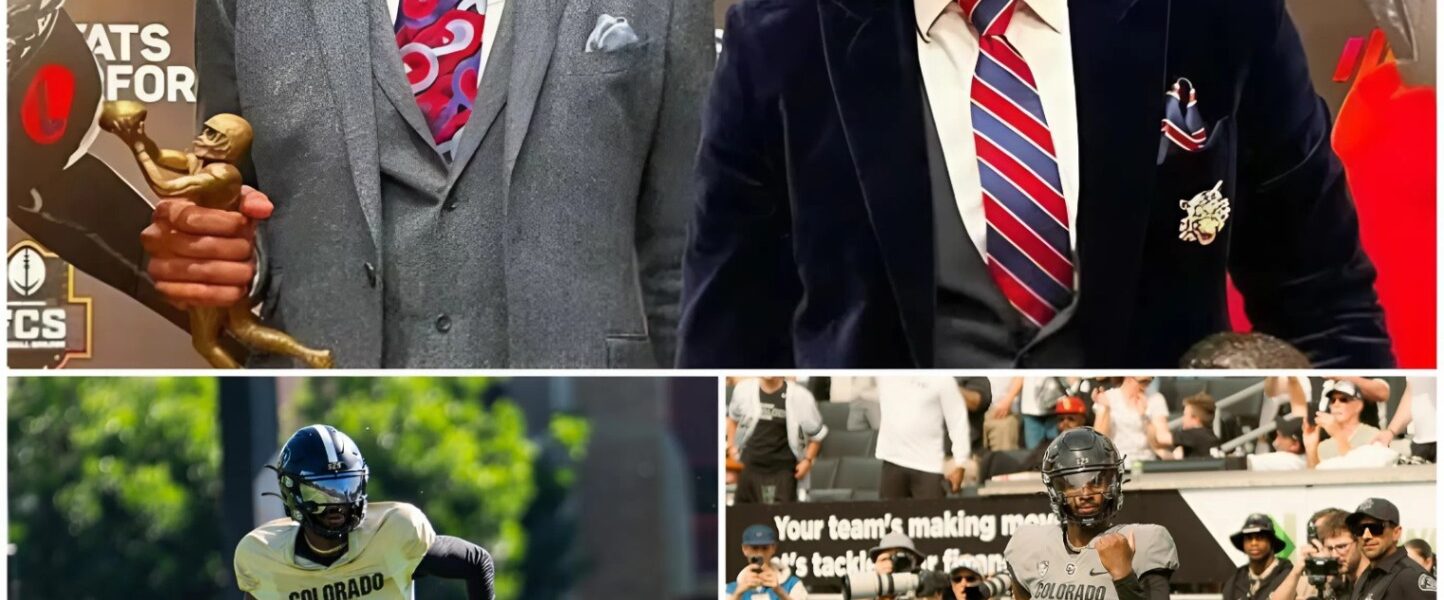

In a world where expectations can crush even the most gifted talents, Shedeur Sanders didn’t just survive the pressure—he transformed it into fuel. Born into the spotlight as the son of NFL legend Deion Sanders, Shedeur’s journey was never going to be ordinary. But what many assumed would be a smooth, privilege-filled path quickly revealed itself to be something far more grueling: a relentless pursuit of greatness shaped by discipline, doubt, and determination.
:max_bytes(150000):strip_icc():focal(539x0:541x2)/Shedeur-Sanders-and-Deion-Sanders-b16784fe576d4b078f9df318f9d75c36.jpg)
A Name That Carried Weight
From the moment he first stepped onto a football field, Shedeur wasn’t just another young quarterback—he was Deion’s son. That identity came with both doors opening and critics waiting. Every throw, every mistake, every decision was scrutinized under a microscope few young athletes ever experience.
But behind the scenes, the narrative was very different. While fans saw flashes of talent, they didn’t see the early mornings, the endless repetitions, or the mental battles that came with trying to prove he was more than a legacy name.
“I had to work twice as hard just to be seen as half as good,” Shedeur once admitted in an interview.
Built, Not Given
Unlike many assumed, nothing about Shedeur’s development was handed to him. Under the guidance—and often the tough love—of his father, he was pushed beyond comfort. Training sessions weren’t about highlight plays; they were about precision, decision-making, and resilience.
At Jackson State University, where he began his college career, Shedeur quickly demonstrated that he wasn’t there for publicity—he was there to win. Leading the team with poise far beyond his years, he showed an ability to read defenses, extend plays, and command respect in the locker room.
Yet even in success, doubt followed him.
Critics argued his achievements were inflated by his father’s presence as head coach. Analysts questioned whether his stats would hold up against tougher competition. Social media, relentless as ever, dissected every performance.
For Shedeur, it became a test not just of skill—but of identity.

The Transfer That Changed Everything
When Deion Sanders made the high-profile move to the University of Colorado Boulder, Shedeur followed. It was more than a transfer—it was a statement.
Stepping into a Power Five conference meant stepping into a harsher spotlight. The defenses were faster. The hits were harder. The margin for error? Nearly nonexistent.
And yet, Shedeur thrived.
Game after game, he displayed a calmness that defied the chaos around him. Whether standing tall in collapsing pockets or delivering pinpoint passes under pressure, he began to shift the narrative. No longer just a promising player—he was becoming a leader, a symbol of belief for a program in transition.
Pain, Pressure, and Perseverance
What truly defines Shedeur’s journey isn’t just the wins—it’s how he responded to adversity.
Throughout his career, he’s endured brutal hits, injuries, and moments where the odds seemed stacked against him. There were games where the offensive line faltered, where protection broke down, where every snap felt like survival.
But he stayed.
He stood in the pocket when others might have fled. He took hits that would shake confidence. And he kept getting up.
That resilience became his identity.
Teammates began to rally around him—not because of his last name, but because of his toughness. Coaches trusted him—not because of hype, but because of his preparation.

Beyond the Field
Off the field, Shedeur’s growth has been just as significant. Navigating fame in the era of NIL (Name, Image, Likeness), he has built a personal brand that reflects both confidence and authenticity. Yet, unlike many young stars, he carries himself with a sense of purpose shaped by his journey.
He understands the influence he holds.
Young fans see themselves in him—not just because of his talent, but because of his perseverance. His story resonates with those who have ever been underestimated, mislabeled, or overshadowed by expectations.
The Mental Game
Perhaps Shedeur’s greatest strength isn’t physical—it’s mental.
In football, where a single mistake can define a game, his ability to reset, refocus, and respond has set him apart. He doesn’t dwell. He adapts.
That mindset didn’t come overnight. It was forged through criticism, through losses, through moments where belief had to come from within rather than from the outside world.
“I don’t play to prove people wrong,” he once said. “I play to prove myself right.”
A Legacy of His Own
As his career continues to unfold, one thing is becoming increasingly clear: Shedeur Sanders is no longer just part of someone else’s legacy—he’s building his own.
The narrative has shifted.
He’s no longer “Deion’s son.”
He’s a quarterback who can lead.
A competitor who can endure.
A figure who represents the grind behind the glamour.

The Road Ahead
The future remains unwritten, but the foundation is undeniable.
With aspirations that extend beyond college football and into the professional ranks, Shedeur carries not just talent—but experience forged under unique pressure. He has already faced expectations that many players will never encounter.
And he’s still standing.
Still working.
Still improving.
Still proving.
Final Thoughts
In an era obsessed with instant success, Shedeur Sanders represents something deeper: the reality that greatness is rarely given—it is earned through unseen effort, unwavering belief, and the courage to endure when the spotlight feels more like a burden than a blessing.
His journey is far from over.
But if there’s one thing we’ve learned so far, it’s this:
Shedeur Sanders isn’t just chasing greatness—he’s building it, one challenge at a time