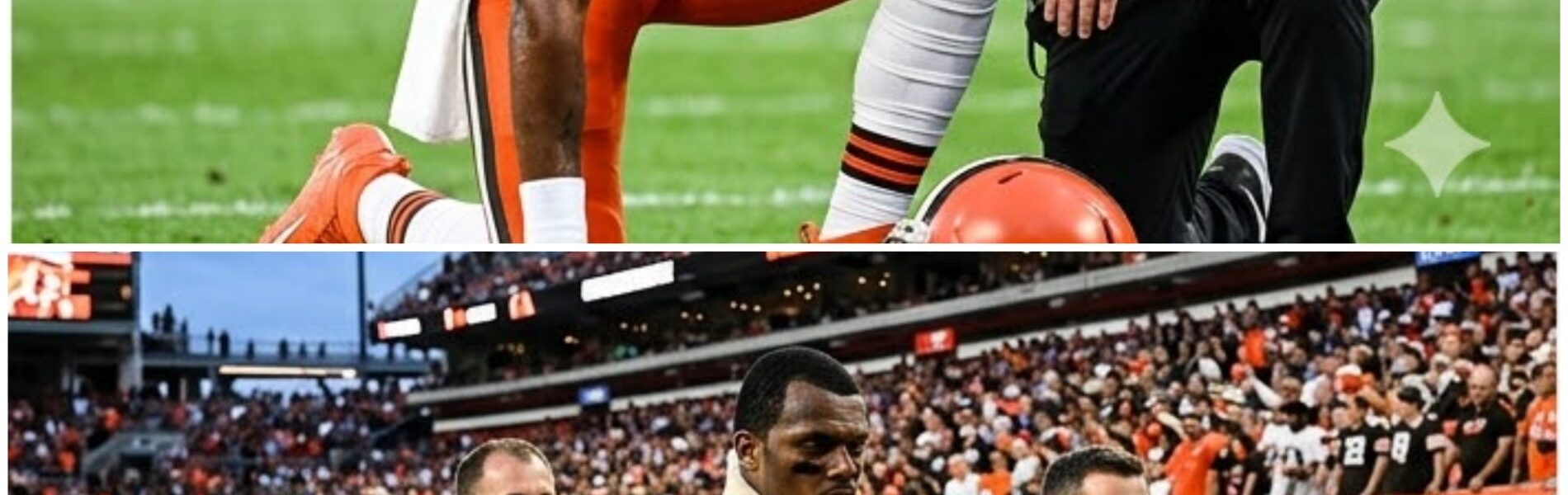
$230 Million Gamble Under Fire: Injury and Controversy Surround Deshaun Watson’s Future with the Cleveland Browns

The National Football League is no stranger to high-stakes contracts, superstar expectations, and the relentless scrutiny that follows both. But few deals in recent memory have sparked as much debate, criticism, and outright disbelief as the fully guaranteed $230 million contract awarded to Deshaun Watson. Now, with a fresh wave of injury concerns clouding his future, what was once seen as a bold, franchise-defining move is increasingly being labeled by critics as one of the worst contracts in NFL history.
When the Cleveland Browns made the blockbuster decision to acquire Watson and sign him to a fully guaranteed deal in 2022, the message was clear: they were all-in. The franchise, long searching for stability at the quarterback position, believed it had finally found its answer—a dynamic, Pro Bowl-caliber talent capable of transforming the team into a legitimate Super Bowl contender.
At the time, the move was controversial but undeniably ambitious. Watson had shown elite ability during his tenure with the Houston Texans, leading the league in passing yards in 2020 and demonstrating the kind of playmaking skill that can elevate an entire roster. For the Browns, it was a calculated risk—one that required not just financial commitment, but a willingness to weather public scrutiny and long-term uncertainty.
Fast forward to today, and that risk is under intense examination.
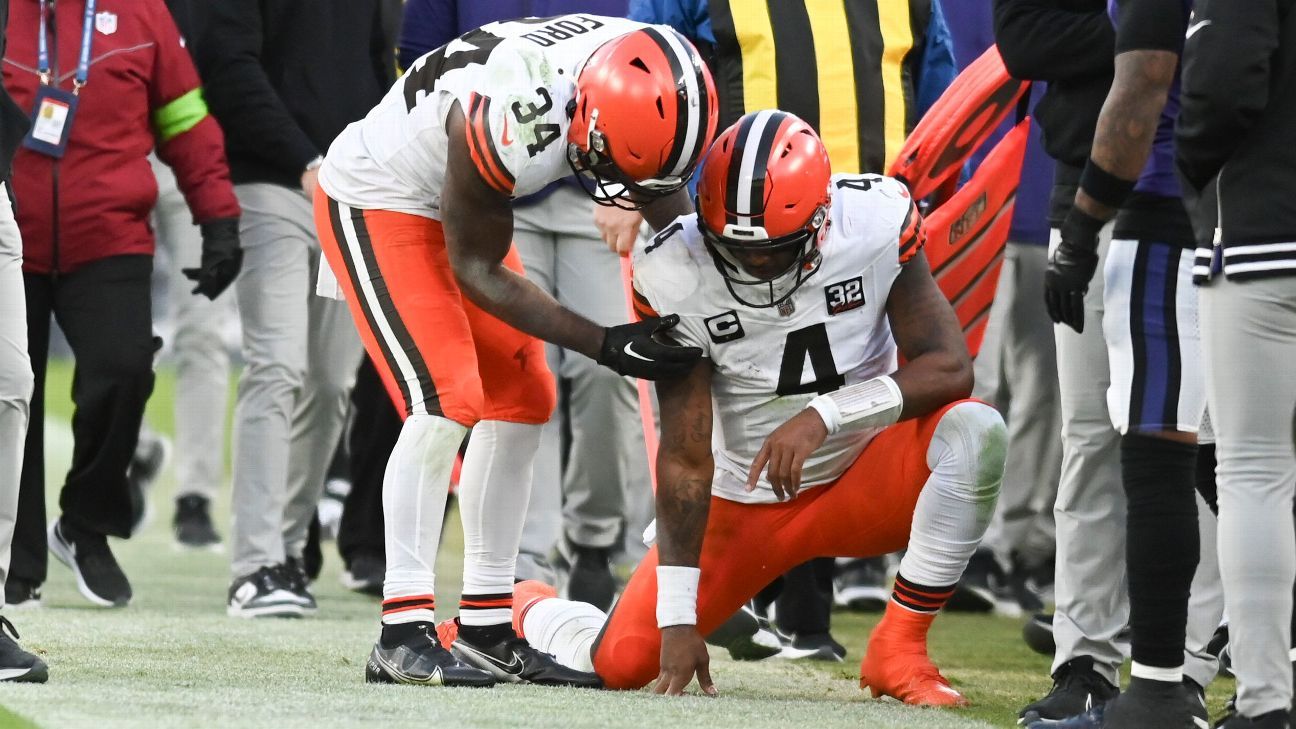
Watson’s latest injury has reignited concerns that have been simmering for months. Availability is one of the most valuable traits in professional sports, and for a player commanding such a massive portion of a team’s salary cap, the expectation is simple: he must be on the field—and performing at a high level. Unfortunately for Cleveland, that hasn’t consistently been the case.
Injuries have limited Watson’s ability to build rhythm and chemistry with his teammates, and each absence only amplifies the pressure surrounding his contract. Fans and analysts alike are asking the same question: how can a team justify such a historic financial commitment when the return on investment remains so uncertain?
The criticism isn’t just about health—it’s also about performance.
Since joining the Browns, Watson has struggled at times to recapture the elite form that once made him one of the league’s most feared quarterbacks. While flashes of brilliance have appeared, they have been inconsistent, often overshadowed by uneven play and missed opportunities. For a player earning top-tier money, inconsistency is not just disappointing—it’s unacceptable in the eyes of many.

This combination of injury setbacks and fluctuating performance has led to a growing narrative: that the Browns may have overpaid, and significantly so.
Across sports media, the phrase “worst contract in history” has begun to surface with increasing frequency. While such statements are often exaggerated for effect, the underlying sentiment reflects a broader concern about roster construction and financial flexibility. A fully guaranteed deal of this magnitude leaves little room for error. If the player does not perform at an elite level, the consequences ripple across the entire organization.
For Cleveland, those consequences are becoming more visible.
The team’s ability to invest in other key areas—whether it’s strengthening the offensive line, adding defensive depth, or retaining emerging talent—is directly impacted by Watson’s contract. In a league defined by parity and razor-thin margins, even small financial constraints can make a significant difference.
Yet, despite the mounting criticism, it would be premature to declare the experiment a complete failure.
Quarterback careers are often defined by resilience and reinvention. Injuries can be overcome. Slumps can be corrected. And narratives can shift dramatically with a string of strong performances. Watson still possesses the physical tools and experience that once placed him among the NFL’s elite. The question is whether he can rediscover that level consistently—and whether his body will allow him to do so.
Inside the Browns organization, there remains a sense of cautious optimism. Coaches and teammates have publicly supported Watson, emphasizing his work ethic, leadership, and determination to return stronger. They understand that the stakes are high, but they also recognize that the season—and his tenure in Cleveland—is far from over.
For fans, however, patience is wearing thin.
The expectations that accompanied Watson’s arrival were enormous, and anything short of sustained success feels like a letdown. Every missed game, every underwhelming performance, and every new injury update adds fuel to the fire of criticism. In today’s media landscape, where narratives can shift overnight, the pressure is relentless.
And yet, this is precisely what comes with a $230 million price tag.
Watson’s situation serves as a broader reflection of the evolving economics of the NFL. As quarterback salaries continue to rise, teams are increasingly willing to take massive risks in pursuit of franchise-defining talent. Some of those risks pay off spectacularly. Others, like the one currently unfolding in Cleveland, become cautionary tales—at least temporarily.

Ultimately, the story of Deshaun Watson and the Cleveland Browns is still being written.
If Watson can return to form, stay healthy, and lead the team to postseason success, the narrative could shift from “worst contract” to “bold move that paid off.” But if injuries persist and performance remains inconsistent, the criticism will only grow louder—and more justified.
For now, the Browns find themselves in a precarious position, caught between hope and doubt, investment and uncertainty.
One thing is certain: in the high-stakes world of the NFL, few stories are as compelling—or as polarizing—as this one.
https://www.youtube.com/watch?v=AGaQppmb6WM