CLARK EFFECT EXPLODES! Caitlin Clark just helped deliver another MASSIVE WNBA ratings record — and fans are bringing back the “MICHAEL JORDAN OF THE WNBA!” comparisons.
Caitlin Clark did not need to win the game to produce one of the biggest victories of the WNBA postseason.
The television numbers did that for her.
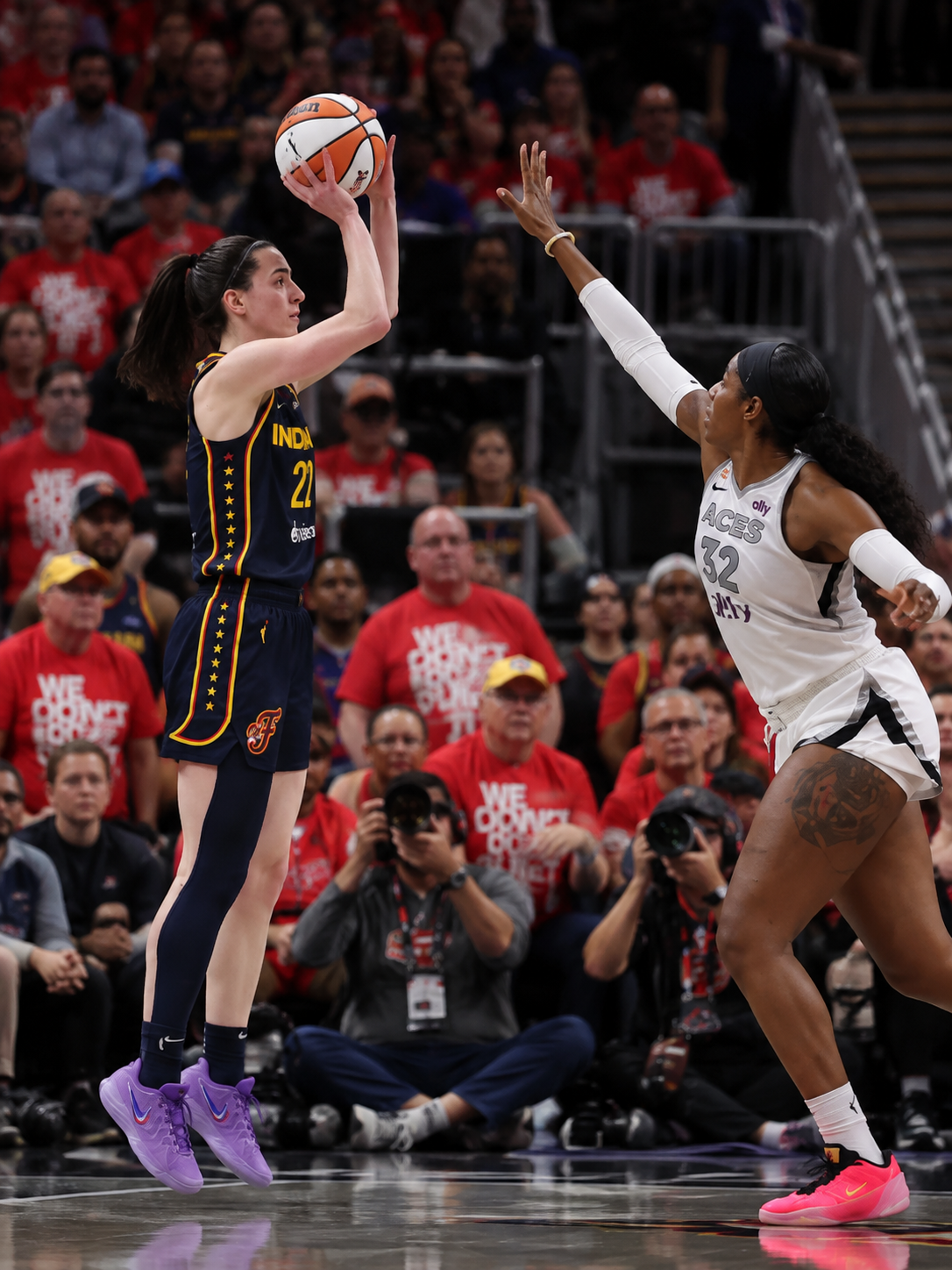
When Clark and the Indiana Fever faced the Las Vegas Aces in the opening game of their playoff series, millions of viewers tuned in — enough to give ABC its most-watched WNBA playoff game ever.
The matchup averaged 2.1 million viewers and peaked at approximately 2.6 million, according to published ratings data. Even more striking, the audience was 122% larger than the comparable first-round Game 1 on ABC last season, when Indiana played Atlanta without Clark available.
And there was another detail that made the number difficult to ignore.
The game aired on an NFL Sunday.
That means a WNBA playoff game involving Clark was attracting more than two million viewers while competing directly with the most powerful television product in American sports.
For anyone wondering whether the extraordinary attention surrounding Clark has started to fade, the latest numbers suggest the opposite.
The Record Needs One Important Clarification
Some viral headlines have described Fever-Aces as the most-watched WNBA playoff game ever.
That is slightly too broad.
It was the most-watched WNBA playoff game ever on ABC, and the Associated Press reported it as the third-most-watched WNBA game on an ESPN network.
That distinction matters because several other WNBA broadcasts have produced larger audiences.
Earlier this season, Indiana’s game against Atlanta averaged about 2.58 million viewers on ESPN, becoming the most-watched WNBA regular-season or postseason game ever on cable.
A Fever-Chicago game in August averaged 3.31 million viewers across NBC’s measured audience and streaming, making it the league’s largest regular-season television audience since 1997.
So the story is not that Clark just produced the biggest audience in league history.
The more interesting story is that she keeps appearing in the games that produce these milestones.
Again.
And again.
And again.

Indiana Has Become Television’s Favorite WNBA Team
The pattern extends far beyond one playoff game.
ESPN said its 2026 WNBA regular season was the most watched in network history, averaging 1.37 million viewers across 29 games.
Five games on ESPN networks averaged more than two million viewers.
Every one of those five involved the Indiana Fever.
That is an extraordinary concentration of audience around one franchise.
Non-Indiana games on those networks averaged 984,000 viewers during the season, according to ESPN.
That does not mean other stars or teams are unimportant.
A’ja Wilson remains one of the league’s defining players. The Aces have championship history. New York, Minnesota and other teams bring major talent and established fan bases.
But television numbers measure behavior rather than arguments.
People either watch or they do not.
And when Clark is playing, particularly in nationally televised games, unusually large numbers of people continue to watch.
The NFL Sunday Detail Might Be the Most Impressive Number
Context makes the 2.1 million average particularly interesting.
Sunday afternoons in the fall belong to the NFL.
Networks build entire programming strategies around avoiding unnecessary competition with football because NFL audiences operate on a different scale from almost everything else in American television.
Yet Fever-Aces still averaged more than two million viewers.
The Associated Press specifically noted that the record ABC playoff audience came while the game was competing against NFL programming.
That does not mean the WNBA is suddenly competing with the NFL in total audience.
It isn’t.
But it suggests that Clark has helped create a segment of viewers willing to seek out Indiana games even when major football broadcasts are happening elsewhere.
That is valuable.
Not simply for Indiana.
For everyone connected to the league.
Networks get stronger ratings.
Advertisers get larger audiences.
Opponents receive greater exposure.
Arenas get more attention.
And players who share the court with Clark are being seen by viewers who may never previously have watched a WNBA game.

Why the “Michael Jordan” Comparison Keeps Appearing
The YouTube commentary surrounding the ratings referred to Clark as something resembling the “Michael Jordan of the WNBA.”
From a basketball standpoint, that comparison is far too complicated to treat literally.
Jordan won six NBA championships, five MVP awards and became one of the most accomplished players in basketball history.
Clark’s professional career is still young.
But the comparison becomes more understandable when it is limited to audience impact.
Jordan was not merely a great basketball player.
He became an event.
People who were not Chicago Bulls fans watched Chicago because Jordan was playing.
Casual viewers recognized him.
Television networks wanted his games.
His presence expanded interest beyond traditional basketball audiences.
That is the part of the analogy increasingly being applied to Clark.
Not championships.
Not career accomplishments.
Attention.
When Indiana plays, people who might otherwise ignore the WNBA often tune in.
The numbers make that increasingly difficult to dismiss.
And Clark Followed the Ratings Record With an Extraordinary Performance
There was an ironic detail about the record-setting Game 1.
Indiana lost.
The Aces took the series opener, meaning Clark’s biggest basketball moment of the matchup was still ahead.
In Game 2, with Indiana needing a victory, Clark responded with 27 points, 15 assists and seven rebounds as the Fever won 99-89.
She became the first player in WNBA history to record at least 25 points and 15 assists in a game, adding another statistical milestone to the attention already surrounding the series.
That combination is exactly why broadcasters remain fascinated by Indiana.
The audience arrives expecting something.
And Clark has developed a habit of giving them something to discuss afterward.
It might be a deep three-pointer.
A spectacular pass.
A huge assist total.
A confrontation.
A record.
Or simply a game that attracts a television audience nobody expected women’s professional basketball to reach a few years ago.
The Bigger Change Started Long Before These Playoffs
Clark’s ability to attract massive audiences did not begin in the WNBA.
Her final college season at Iowa produced two of the most-watched women’s college basketball games ever.
The 2024 national championship game between Iowa and South Carolina averaged 18.7 million viewers, an astonishing number that even exceeded the audience for the men’s championship game the following day.
That audience followed her into professional basketball.
According to the AP, Indiana averaged slightly more than 4,000 fans per home game before Clark arrived.
This season, that number had grown to more than four times that level, while Indiana also became the league’s strongest road attendance attraction.
Those numbers make it increasingly difficult to describe what is happening as a temporary rookie phenomenon.
Clark is now in her third WNBA season.
The ratings remain enormous.
What Happens Next Could Be Even Bigger
The most intriguing part is that Fever-Aces Game 1 may not even produce the largest audience of the series.
After Indiana answered with its 99-89 Game 2 victory, the matchup moved toward a deciding Game 3.
Now the stakes are simple.
Win and advance.
Lose and go home.
Add Clark, Wilson, the developing rivalry between the teams and all the controversy surrounding the series, and there is every reason for television executives to watch the next ratings report closely.
But the broader conclusion is already becoming difficult to ignore.
Caitlin Clark does not merely generate highlights.
She generates viewers.
The Fever-Aces opener averaged 2.1 million people and peaked at 2.6 million while competing with NFL Sunday.
It shattered ABC’s WNBA playoff record.
And perhaps most importantly, it was not an isolated event.
It was simply the latest entry in a growing list of record television audiences involving Indiana.
That may ultimately be Clark’s biggest impact on the WNBA.
She is not only changing what happens when the ball is in her hands.
She is changing how many people are watching when it happens.
