Clint Eastwood’s The Outlaw Josey Wales Starts With Revenge — Then Becomes a Story About the Family an Outlaw Never Expected to Find top1
Josey Wales begins the movie digging a grave.
His Missouri farm has been burned.
His wife and son are dead.
The men responsible are still alive.
From that moment, Clint Eastwood’s 1976 Western The Outlaw Josey Wales appears to be heading toward a familiar destination: one wounded man, one gun, and a trail of revenge stretching across the frontier.
But the film gradually becomes something more complicated.
Josey spends much of the story insisting that he wants to be left alone.
Instead, people keep joining him.
A Cherokee wanderer.
A young Navajo woman.
An elderly settler.
A frightened family.
By the time the guns finally fall silent, the man who began with nothing left to lose has accidentally built something worth protecting.
That is why The Outlaw Josey Wales works so well as a full-movie Western rather than just a collection of shootouts. Revenge drives Josey out of Missouri.
But survival, loyalty and reconciliation slowly give him somewhere to go.
The film was released in 1976, directed by Eastwood and produced by his Malpaso Company for Warner Bros. It runs roughly 135 minutes and stars Eastwood alongside Chief Dan George, Sondra Locke, Bill McKinney, John Vernon, Sam Bottoms, Geraldine Keams and Will Sampson. It was adapted from Forrest Carter’s novel Gone to Texas. Catalog
Josey Wales Becomes an Outlaw Because the War Refuses to End
The Civil War destroys Josey’s first life.
After Union-aligned Red Legs led by Terrill attack his home and kill his family, Josey joins Confederate guerrillas fighting in Missouri.
Then the war ends.
Most of his comrades surrender.
Josey does not.
His suspicion proves justified when the surrendering guerrillas are massacred.
Suddenly he is not simply a former soldier refusing to accept defeat.
He is a hunted man.
Terrill wants him dead.
Federal forces want him captured.
Bounty hunters hear his name and see money.
Josey rides south toward Texas with violence following behind him.
Eastwood plays much of this without unnecessary explanation.
Josey rarely discusses grief directly.
He carries it.
The dirt-covered clothes, the beard, the narrowed eyes and the constant awareness of where his guns are become part of the character.
What looks like classic Western toughness is also isolation.
Josey does not trust institutions because every institution he has encountered has failed him.
Then Lone Watie walks into his life.
Chief Dan George’s performance changes the film’s rhythm almost immediately.
Lone Watie talks where Josey stays quiet.
He observes.
Comments.
Questions.
And refuses to disappear simply because Josey appears determined to travel alone.
TCM has described the film as bridging older classical Western traditions with the more personal, revisionist filmmaking of the 1970s. That tension is visible in Josey himself: he resembles the traditional lone gunfighter, but the movie keeps undermining his ability to remain alone. Turner Classic Movies
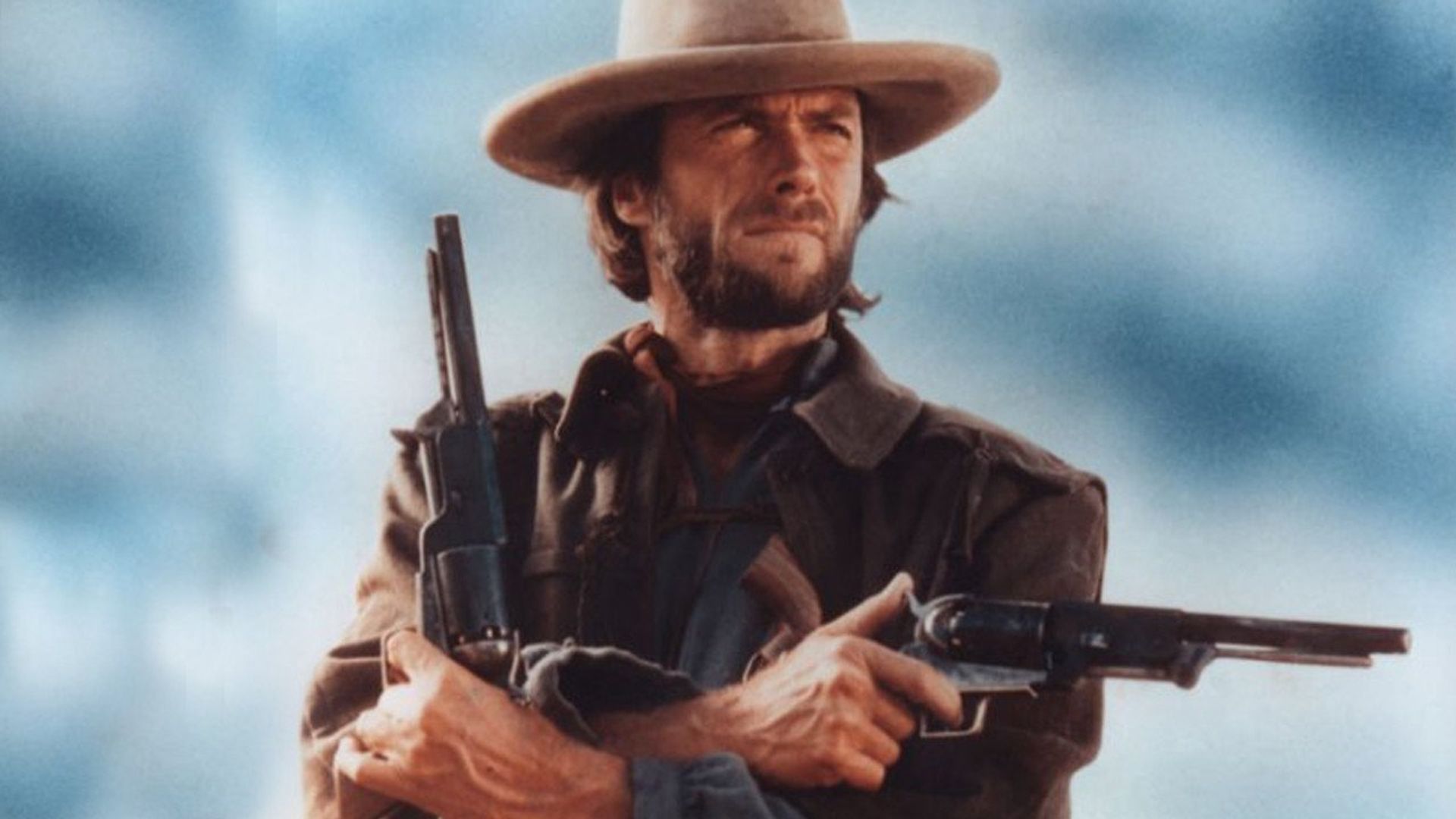
One companion becomes several.
Josey and Lone Watie encounter Little Moonlight, played by Geraldine Keams.
Later come Grandma Sarah and Laura Lee, played by Paula Trueman and Sondra Locke.
Josey never formally announces that these people are now his responsibility.
He simply begins acting as though they are.
That is one of the film’s strongest ideas.
His first family was taken from him violently.
His second family forms almost accidentally.
And every new attachment creates a problem for a man who has survived by expecting loss.
The Most Important Confrontation Is Not a Gunfight
Some of the film’s best moments involve Josey drawing faster than the men trying to kill him.
But one of the most revealing scenes happens when he approaches Ten Bears, the Comanche leader played by Will Sampson.
Josey could prepare for war.
Instead, he talks.
He offers a choice between continued killing and an agreement that allows both sides to live.
The scene matters because it shows how far Josey has traveled emotionally.
At the beginning, violence is almost the only language left to him.
Here, he recognizes that another path exists.
That does not suddenly turn him into a pacifist.
Far from it.
Terrill is still coming.
Josey still knows that some men will not negotiate.
But the meeting with Ten Bears separates violence used for survival from violence pursued simply because hatred has become a habit.

That distinction gives the final stretch its weight.
Josey finally has a home again.
That means he finally has something to lose again.
Terrill and his men arrive.
The quiet settlement becomes a battlefield.
Josey and the people around him fight not for the Confederacy, not for abstract revenge, but because this small community has become theirs.
And once Josey chases Terrill down, the final confrontation deliberately reaches back to the beginning.
The Library of Congress essay on the film notes the visual symmetry of Terrill’s saber: the weapon associated with Josey’s trauma ultimately becomes the instrument through which that chapter of his life is ended. The same essay argues that beneath the violence, the movie is fundamentally concerned with forgiveness, reconciliation and damaged people creating a community together. The Library of Congress
The Ending Refuses the Simplest Western Payoff
Josey survives.
But the film does not finish by celebrating another body on the ground.
Instead, Fletcher, the former Confederate captain who has spent much of the movie reluctantly helping the authorities pursue Josey, finally encounters him.
By then, the question is no longer whether Josey can shoot his way out.
It is whether the past will ever allow him to stop running.
The ending offers him that possibility.
Not innocence.
Not the restoration of what he lost.
A future.
That is a very different reward.

The film’s reputation also grew well beyond its initial reception. Contemporary reviews were mixed, with some critics objecting to the running time and violence, but The Outlaw Josey Wales was selected for the National Film Registry in 1996, meaning the Library of Congress recognized it as culturally, historically or aesthetically significant and worthy of preservation. Catalog
Eastwood’s production history adds another layer. Philip Kaufman originally began directing the film after adapting the novel, but Eastwood replaced him after filming had started because of creative differences and completed the picture himself. Location work included Utah, Arizona and California. Catalog
Yet none of that is what makes the full movie linger.
It is the transformation.
Josey begins beside a grave.
He spends the film convinced that survival means needing nobody.
Then one person rides beside him.
Then another.
Then another.
By the end, the outlaw who thought revenge was the only thing keeping him alive discovers something harder than killing the men who destroyed his first home:
allowing himself to have another one.
FULL MOVIE
The Outlaw Josey Wales (1976)
Label: LEGAL FULL MOVIE — DIGITAL VERSION
