“He Walked Into the Saloon With a Black Man… Then Shot the Sheriff!” — The Shocking Django Unchained Scene That Changes Everything
Two Strangers Walk Into a Saloon — And Everything Changes
Western movies have always been filled with dangerous strangers, suspicious townspeople, and sudden violence. But few saloon encounters are as unforgettable as the extraordinary confrontation in Quentin Tarantino’s Django Unchained (2012).
The scene begins with two men entering a saloon in the small town of Daughtrey.
One is Django, portrayed by Jamie Foxx, a formerly enslaved man beginning a new chapter of his life.
The other is Dr. King Schultz, played by Christoph Waltz, a German-born bounty hunter whose polite manners conceal a dangerous profession.
Their arrival immediately creates discomfort.

In the racist society depicted by the film, a Black man entering a white establishment as an equal is treated as an unacceptable challenge to the established order.
But Schultz refuses to behave according to the town’s expectations.
Instead, he calmly sits down with Django as though they have every right to be there.
What follows is a brilliant combination of dark humor, suspense, and unexpected violence.
The Bartender’s Reaction Reveals the Town’s Prejudice
The innkeeper quickly realizes that Django is not entering the saloon in the role the townspeople expect.
He is accompanying Schultz as a free man.
This is enough to provoke panic.
Rather than serve the visitors normally, the frightened proprietor attempts to summon the authorities.
Schultz, however, remains remarkably calm.
He does not apologize for Django’s presence or attempt to explain away their relationship.
Instead, he treats the situation as an ordinary visit to an establishment where travelers might enjoy a drink.
His relaxed behavior contrasts sharply with the fear and prejudice surrounding him.
For Django, the moment is particularly significant.
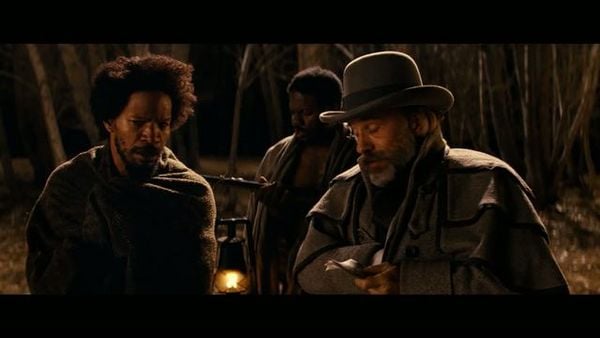
He is beginning to experience a different relationship with a society that has previously treated him as property.
The scene also establishes the unusual dynamic between the two protagonists.
Schultz speaks with confidence because he understands the legal system and how to manipulate its assumptions.
Django watches carefully, learning that intelligence and preparation can be just as powerful as a firearm.
The Sheriff Arrives — But Schultz Has a Secret
As tension builds, the local sheriff approaches the saloon.
To the townspeople, his arrival promises a return to order.
Surely the sheriff will remove these unwelcome strangers and restore the authority that appears to have been challenged.
But Schultz behaves as though he has been expecting this moment.
There is no frantic attempt to flee.
No desperate bargaining.
No visible surrender.
Instead, the bounty hunter waits with a confidence that suggests he knows something nobody else does.
The sheriff confronts the men, expecting his badge to command immediate obedience.
For a moment, the scene resembles a conventional Western standoff.
But Tarantino has constructed something far more surprising.

Schultz is not intimidated by the sheriff.
He has a reason for being there, and the audience has not yet been told what it is.
That withheld information becomes the key to the scene’s suspense.
One Sudden Gunshot Changes the Entire Town
Without giving the sheriff the response he expects, Schultz suddenly draws a concealed handgun and shoots him.
The violence is immediate and shocking.
The sheriff collapses, and Schultz fires again, killing him.
A confrontation that seemed likely to end with two strangers being driven out of town has suddenly become a killing in broad daylight.
The townspeople scatter in panic.
Witnesses are horrified.
From their perspective, a stranger has just murdered an elected lawman.
Yet Schultz behaves with extraordinary composure.
Rather than flee the town, he returns to the saloon with Django.
He even directs the frightened innkeeper to summon the U.S. marshal.
This decision seems almost unbelievable.
Why would a man who has just killed the sheriff voluntarily invite additional law enforcement officers to confront him?
The answer is central to the brilliance of the sequence.
Schultz knows that the town does not understand what has just happened.
And he intends to use that ignorance to his advantage.
Why the Scene Works So Well


Tarantino builds the confrontation around a reversal of expectations.
The apparently respectable authority figure is not necessarily what he seems.
The suspicious outsider may understand the law better than the town’s own officials.
And Django, whose presence initially causes the disturbance, becomes a silent observer of a much larger revelation.
Christoph Waltz delivers the sequence with remarkable control.
His Schultz is courteous, articulate, and almost playful.
But beneath that civilized exterior is a professional bounty hunter capable of sudden lethal action.
Jamie Foxx gives Django a quieter presence, allowing the audience to experience the shock and uncertainty through his reactions.
Together, the actors create a memorable contrast between confidence and discovery.
The scene is about more than a shooting.
It challenges assumptions about respectability, authority, freedom, and who gets to decide what justice looks like.

Final Thoughts: The Shot That Leads to an Even Bigger Surprise
The saloon confrontation begins with an act of racial prejudice and ends with an elected sheriff lying dead in the street.
For the townspeople, Schultz appears to be a dangerous criminal.
For Django, his companion’s behavior raises new questions about the mysterious profession of bounty hunting.
But the most astonishing revelation has not yet arrived.
Schultz has deliberately created a confrontation in which the entire town believes he is guilty.
Now the U.S. marshal is coming.
And when the truth about the dead sheriff finally emerges, the meaning of everything the audience has witnessed will change.
The shooting is only the beginning. The real surprise comes when Schultz explains why he pulled the trigger.
