“No Mercy, No Surrender, No Way Out!” — How The Wild Bunch (1969) Redefined Violence in Hollywood Westerns
Few opening lines in Western cinema capture the danger, brutality, and moral darkness of a movie as powerfully as this unforgettable command from The Wild Bunch (1969).
Directed by the legendary Sam Peckinpah, this groundbreaking Western shattered the romantic image of the American frontier. Instead of presenting honorable gunslingers, noble sheriffs, and clean-cut heroes, Peckinpah introduced audiences to a world where loyalty was fragile, violence was merciless, and survival often demanded terrible sacrifices.
Released during a period of intense social and political upheaval, The Wild Bunch became one of Hollywood’s most controversial films.

Some critics condemned its graphic violence. Others praised its uncompromising portrayal of a dying era.
But one thing was undeniable: Western cinema would never look quite the same again.
More than five decades later, the film remains a masterpiece of action, tragedy, and cinematic storytelling.
The Opening Robbery That Explodes Into Chaos
The story begins with a gang of aging outlaws preparing to rob a railroad payroll office.
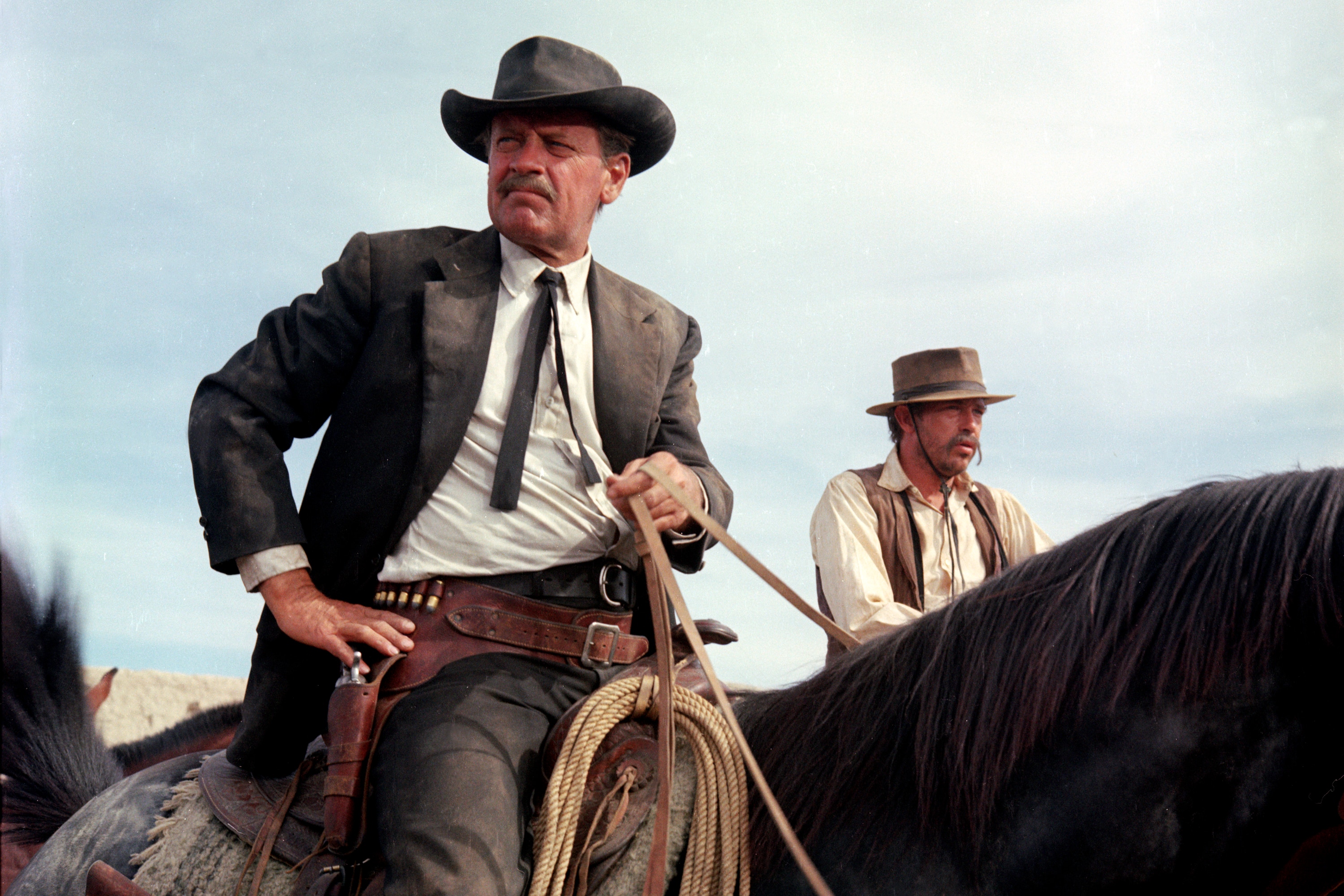
Their leader, Pike Bishop, portrayed by William Holden, is a hardened criminal who understands that the world around him is changing.
He commands a small group of dangerous men who have survived years of violence, betrayal, and narrow escapes.
Among them are Dutch Engstrom, played by Ernest Borgnine; Angel, portrayed by Jaime Sánchez; and the unpredictable Gorch brothers, played by Warren Oates and Ben Johnson.
At first, the robbery appears straightforward.
But the gang has walked into a deadly trap.

Waiting for them is a group of bounty hunters led by Deke Thornton, played by Robert Ryan.
Thornton is no ordinary enemy.
He is Pike’s former partner, a man forced into hunting someone he once trusted.
When the ambush begins, the peaceful town transforms into a battlefield.
Gunshots erupt. Innocent civilians are caught in the crossfire. Men fall in the streets as the robbery collapses into chaos.
Peckinpah uses rapid editing, slow-motion photography, and shocking violence to create a sequence unlike the traditional Western gunfights audiences had grown accustomed to watching.
There is no glamorous victory.
Only confusion, desperation, and death.

Pike Bishop: A Leader Trapped in a Dying World
At the center of the story stands Pike Bishop, one of the most complex antiheroes in Western film history.
William Holden delivers a remarkable performance as a man who has spent his life following an outlaw code but increasingly recognizes that his world is disappearing.
Pike believes in loyalty, yet his past is filled with difficult decisions and painful mistakes.
He demands discipline from his men, but he cannot always control their reckless behavior.
He wants to survive, but he also understands that survival without dignity may eventually become meaningless.
Unlike the idealized cowboys of earlier Westerns, Pike is neither entirely heroic nor purely villainous.
He is exhausted, dangerous, intelligent, and deeply flawed.
His greatest tragedy is that he belongs to an era that no longer has room for men like him.
The American frontier is closing.
Modern weapons, powerful corporations, and expanding government authority are replacing the independence that once defined his life.
For Pike and his companions, there is nowhere left to run.

The Pursuit That Turns Old Friends Into Enemies


After the disastrous robbery, the surviving outlaws escape toward Mexico.
But the danger follows them.
Deke Thornton and his ruthless posse remain determined to capture or kill Pike’s gang.
The relationship between Pike and Thornton adds emotional complexity to the story.
They were once partners who shared the same outlaw lifestyle.
Now they stand on opposite sides of an increasingly brutal conflict.
Thornton is trapped by powerful men who use the threat of imprisonment to force his cooperation.
He must hunt his former friends or face the consequences.
This makes him more than a conventional antagonist.
Like Pike, Thornton is a prisoner of changing times.
Their conflict reflects one of the film’s central themes: even men who once believed themselves free can become trapped by forces larger than themselves.
The pursuit also creates constant pressure.
Every stop carries danger.
Every alliance may conceal betrayal.
And every attempt to escape brings the gang closer to its ultimate reckoning.
Mexico: Where Greed, Corruption, and Violence Collide


The journey into Mexico introduces another dangerous figure: General Mapache, portrayed by Emilio Fernández.
Mapache is a corrupt military commander who uses intimidation and cruelty to maintain his authority.
He becomes involved with the outlaws through a scheme involving stolen American military weapons.
For Pike’s gang, the arrangement offers the possibility of one final lucrative job.
But their hopes of escaping with money quickly collide with the realities of political violence and personal loyalty.
Angel, one of the gang’s younger members, becomes particularly important.
His connection to the Mexican people places him in direct conflict with Mapache’s brutality.
While the other outlaws often focus on money and survival, Angel is driven by a more personal cause.
His fate ultimately forces the gang to confront a question they have spent years avoiding.
What does loyalty mean when protecting a friend could cost everyone their lives?
The Final Walk: Four Outlaws Against an Army
One of the most unforgettable sequences in Western cinema occurs near the film’s conclusion.
After Angel falls into Mapache’s hands, Pike and his remaining companions face an impossible choice.
They can abandon their friend and continue trying to survive.
Or they can confront Mapache, knowing the consequences may be fatal.
For men who have spent their lives running from enemies, responsibility, and the changing world, the decision represents a final opportunity to stand for something.
Pike, Dutch, Lyle, and Tector make their choice.
Together, they walk toward Mapache’s headquarters.
There is no grand speech.
No promise of victory.
No elaborate plan guaranteeing escape.
Only four aging gunmen moving forward with grim determination.
The scene has become legendary because of its simplicity.
These men know the odds.
They understand the danger.
Yet they continue walking.
Their decision transforms the story from a tale of criminals seeking profit into a tragedy about friendship, honor, and sacrifice.

The Explosive Ending That Shocked Hollywood

The final confrontation unleashes one of the most famous gun battles in movie history.
What begins as a tense encounter rapidly descends into extraordinary violence.
Rifles fire. Machine guns thunder. Soldiers collapse as the courtyard becomes a nightmare of smoke, blood, and destruction.
Peckinpah’s revolutionary editing transforms the battle into a chaotic mixture of slow-motion death and rapid-fire action.
The violence feels both spectacular and horrifying.
Rather than presenting gunfighting as a glamorous demonstration of masculine courage, the sequence reveals its destructive consequences.
Every victory carries a terrible price.
Every moment of defiance brings the characters close
